Jurassic Dinos editorial · Updated · Source-based review
Astigmasaura genuflexa was a rebbachisaurid sauropod from Patagonia, Argentina. Rebbachisaurids belong to a different sauropod branch from titanosaurs. The animal was named in 2025, adding another carefully distinguished member to the long-necked dinosaurs known from the Huincul Formation.
Getting the time and place right
The original description identifies rocks of the upper Cenomanian, a subdivision of the Late Cretaceous. An overview used during candidate research incorrectly called the animal Early Cretaceous. The research paper’s geological context takes priority here. Its locality, El Orejano in Neuquén Province, is a place in modern Argentina, not a claim that today’s political boundaries existed when the animal lived.
Rock formations help researchers connect specimens to geological settings. They do not mean that every fossil within a formation lived in the same year or met every other animal found there.
What makes the specimen useful?
The type specimen, MAU-Pv-EO-629, preserves the posterior part of an articulated skeleton. Articulated means that some bones retain their relative connections. The authors describe it as morphologically adult, meaning that its physical development indicates maturity; this is not a birthday recorded in years.
The study highlights information from the tail, pelvis and hind limbs. Comparing these regions allows researchers to distinguish Astigmasaura from other sauropods through a combination of features. A diagnosis works like a set of anatomical checks, rather than a requirement for one enormous horn or a spectacular crest.
What does the picture add?
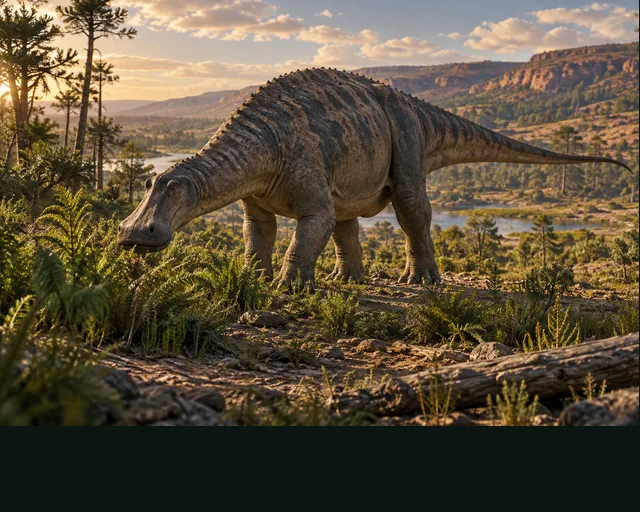
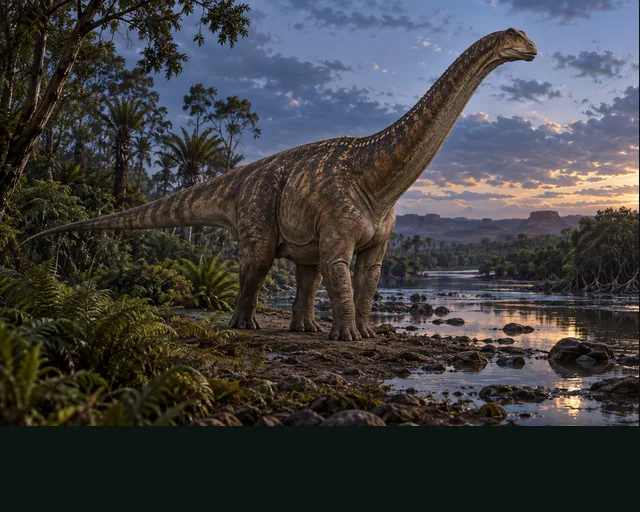
The approved complete reference is Connor Ashbridge’s named restoration of Astigmasaura genuflexa. It depicts a small, low head on a long neck, an elongated torso supported by four columnar legs, and a long tapering tail. The new scene follows that whole-animal artwork.
The fossil is not a complete neck-to-tail skeleton, and the painting must not be read as proof that all those parts were recovered. Skin, colour, soft-tissue proportions and the chosen stance remain interpretations. We do not calculate a precise total length or mass from the artwork. Plant eating is presented as the broad sauropod feeding interpretation, not a documented list of this individual’s favourite plants.
Compare the branch
Read about Rebbachisaurus and Nigersaurus to explore the wider group. Their discoveries provide useful comparisons, but their distinctive anatomy should not be copied automatically into Astigmasaura. Return to the A–Z directory for more fossil stories in which a partial skeleton can still answer an important question.
Quick answers
- When did Astigmasaura live?
- In the Late Cretaceous, represented by upper Cenomanian rocks of the Huincul Formation.
- Was its whole body found?
- No. The type specimen preserves the posterior part of an articulated skeleton, including informative tail and pelvic material.
- Was the specimen an adult?
- The original description calls it morphologically adult; that does not supply an exact age in years.
- Is it a titanosaur?
- No. It is a rebbachisaurid sauropod, a different branch of the long-necked dinosaur family tree.