Jurassic Dinos editorial · Updated · Source-based review
Aristosuchus was a small theropod dinosaur from the Early Cretaceous of England. Its fossils are fragmentary, and its naming history stretches back to Victorian research. This makes it an interesting example of why a scientific name must stay connected to the actual specimen rather than just a familiar-looking picture.
An Isle of Wight name change
Richard Owen described the material in 1876 under the name Poikilopleuron pusillus. Harry Govier Seeley examined it again and established Aristosuchus in 1887. The species label pusillus remained attached to the specimen while its genus assignment changed.
The historical paper discusses bones from the Reverend William Darwin Fox’s collection that entered the British Museum. Such collection history is more than a colourful footnote. It helps researchers establish which pieces were examined, which were illustrated and whether later authors are discussing the same fossil material.
What can the bones tell us?
The important preserved material concerns the region around the pelvis and sacrum, where vertebrae connect the spine with the hips. These structures can provide identifying characters even without a complete skull or an articulated whole skeleton.
A later comparative study by Darren Naish and colleagues discussed similarities between the pubis of Aristosuchus and Compsognathus, treating it as a possible compsognathid. That is a comparative interpretation, not proof that the missing head and covering were identical to another dinosaur’s.
The same discussion noted the long-standing confusion between Aristosuchus and Calamospondylus. Two historical names should not be merged simply because both involve small theropods from a famous fossil island. Researchers must compare descriptions and specimen records before deciding whether names represent the same animal.
A crocodile-sounding dinosaur?
The ending of Aristosuchus can sound crocodilian, but word endings do not determine evolutionary relationships. Anatomical evidence supports its treatment as a theropod dinosaur. Conversely, an animal whose name ends in “saurus” is not automatically a dinosaur.
The broad meat-eating interpretation does not identify a precise prey species, a hunting routine or a maximum adult weight. This page keeps those details uncertain rather than extracting them from an artist’s silhouette.
A hypothetical full body
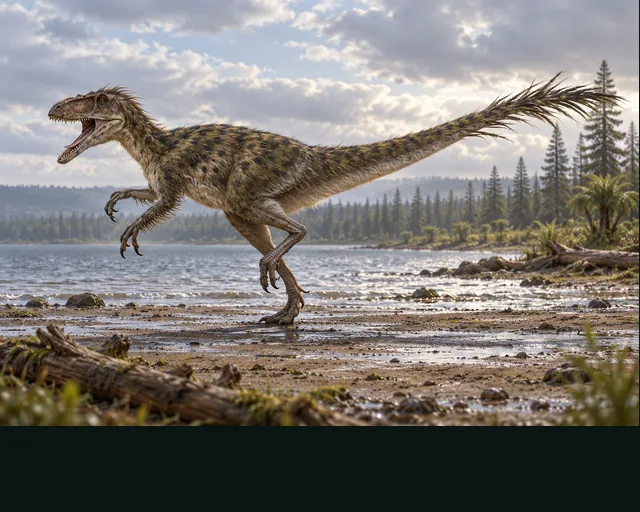
Our image follows FunkMonk’s complete named Aristosuchus restoration. It retains a slender head and neck, grasping forelimbs, long hind legs and a feathered tapering tail. The source artist reconstructed missing regions through comparison, so plumage, proportions and colour remain hypothetical. We do not use the body of Poikilopleuron as a substitute reference.
Compare Compsognathus and Eotyrannus, or explore A–Z under A.
Quick answers
- Where are its fossils from?
- The Early Cretaceous record of the Isle of Wight, England.
- Why does the name Poikilopleuron appear in its history?
- Owen originally assigned pusillus to that genus before Seeley established Aristosuchus.
- Does an old combination make the two genera interchangeable?
- No. Historical assignments can be revised; they do not justify borrowing a different animal’s whole anatomy.
- Was its feathered coat preserved?
- No. The full covering in our image follows a named, explicitly hypothetical restoration.