Jurassic Dinos editorial · Updated · Source-based review
Archaeoceratops was a small, plant-eating dinosaur from Early Cretaceous China. It belonged to the ceratopsian radiation, but its appearance was very different from the giant horned faces that later became famous. Being a ceratopsian does not mean that every member carried three huge horns.
An early ceratopsian from Gansu
The best-known species, Archaeoceratops oshimai, was named by Dong Zhiming and Yoichi Azuma in 1997. Hai-Lu You and Peter Dodson published a detailed redescription in 2003. The material came from the Mazongshan area of Gansu Province in northwestern China.
The name means “ancient horned face”, as the Natural History Museum’s directory explains. Scientific names often refer to a group’s wider identity or historical interpretation. They should not be treated as a literal inventory of every feature on the animal’s head.
Two specimens preserve different clues
The defining specimen includes a nearly complete skull, parts of the backbone and part of the pelvis. Another referred specimen preserves different information, including a nearly complete tail, pelvic material and a complete foot. Studying both expands the anatomical picture, but it does not mean that one complete skeleton was found with every part attached.
The skull is especially valuable because it was preserved in three dimensions. Even so, damage matters. The redescription noted that erosion had removed the parietal bones, limiting what could be established about the frill. A well-preserved skull can still have a scientifically important gap.
Where does it fit in the family tree?
The 2003 study interpreted Archaeoceratops as an early neoceratopsian. Neoceratopsia includes many of the later beaked, frilled dinosaurs. Comparing earlier members helps researchers investigate how the more elaborate heads of later forms evolved.
An early branch is not a ladder rung waiting to become Triceratops. The named animal had its own combination of traits. Claims about direct ancestry require more evidence than an older age and a broadly similar head.
Looking at the modest frill
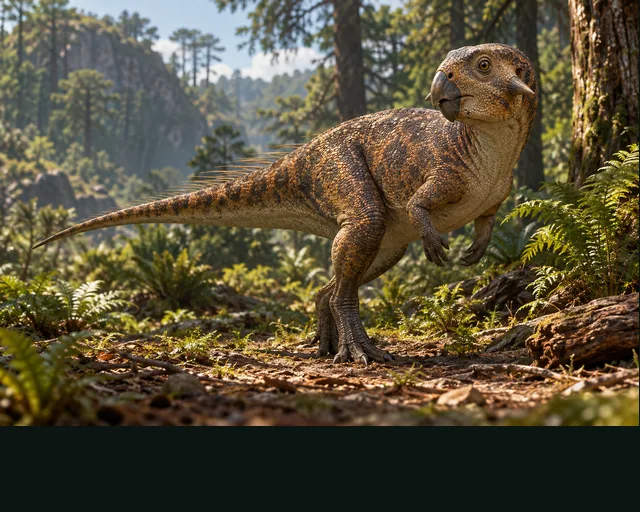
Our illustration follows Andrey Atuchin’s complete restoration published by the Natural History Museum. It shows a small beaked head, a short frill, short forelimbs, longer hind limbs and a balancing tail. We retain that visual reference without adding giant brow horns from a different dinosaur.
The full frill outline, body covering and colours remain reconstructed, especially where fossil damage limits the evidence. Compare Psittacosaurus and Protoceratops, or browse A–Z under A.
Quick answers
- Was Archaeoceratops a miniature Triceratops?
- No. It was a distinct early ceratopsian, with its own anatomy rather than a scaled-down later species.
- Where are the oshimai fossils from?
- The Mazongshan area of Gansu Province, northwestern China.
- Were giant facial horns present in the reference?
- No. The reviewed complete museum restoration shows a small beaked head and modest frill.
- Does the skull preserve every frill detail?
- No. The redescription notes that eroded parietal bones limit interpretation of the frill.