Jurassic Dinos editorial · Updated · Source-based review
Aquilarhinus was a plant-eating duck-billed dinosaur with a particularly unusual front end. Its jaws inspired a shovel-like bill interpretation, while its nasal bones formed a broad arch. These features reveal diversity hidden behind the everyday label “duck-billed dinosaur”.
An animal from Big Bend
Albert Prieto-Márquez, Jonathan Wagner and Thomas Lehman described Aquilarhinus palimentus in a study published online in 2019 and in a journal volume dated 2020. Its fossils came from the lower shale member of the Aguja Formation in Big Bend National Park, Texas. The study assigned this material to the early Campanian, within the Late Cretaceous.
Those rock-unit details matter. Another dinosaur from a different level of the same formation is not automatically an exact contemporary. Fossil sites are parts of a changing landscape preserved through time, not one enormous snapshot.
What made the bill different?
The front processes of the lower jaw were elongated and turned upward. When the two sides met, they formed a W-like outline viewed from the front. Together with the broad skull, this supported the authors’ interpretation of a shovel-shaped bill.
The researchers proposed that such a structure might have helped scoop semiaquatic vegetation. This is a functional hypothesis: an explanation linking a shape with a possible use. It is not a preserved film of the animal feeding, a recovered complete menu or proof that it lived as an aquatic specialist.
To test an idea about feeding, scientists compare anatomy, mechanical possibilities and environmental context. A memorable nickname can introduce the hypothesis, but it should not replace the evidence or erase its uncertainty.
A different kind of crest
Aquilarhinus also had broadly arched nasal bones. This is different from the long hollow tubular crest of some other hadrosaurs. The original study used the animal to investigate the history of hadrosaur crests, including structures outside the best-known saurolophine and lambeosaurine radiation.
Superficial resemblance to Gryposaurus did not make the two the same genus. Smaller anatomical details and the combination of characters were important in their comparison.
Our whole-animal image
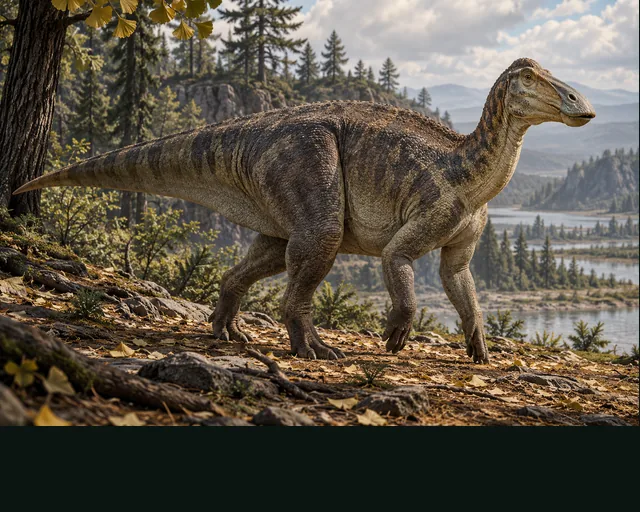
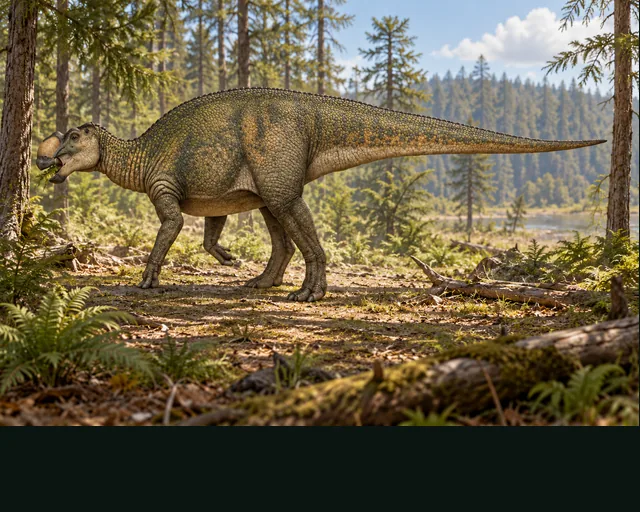
The illustration follows David Breguet’s complete restoration of Aquilarhinus palimentus. It retains a broad, deep snout, high-backed body on four legs and a tapering tail curving down toward the tip. Soft tissues, colour and the particular tail pose remain artistic choices, not directly measured life appearance.
Compare Gryposaurus and Edmontosaurus, or continue exploring A–Z under A.
Quick answers
- Where did Aquilarhinus live?
- In the Late Cretaceous landscape represented by the lower shale member of the Aguja Formation, Texas.
- What was unusual about its jaws?
- The front processes of the lower jaw turned upward and met in a W-like profile, supporting a shovel-shaped bill hypothesis.
- Did researchers see it scoop plants?
- No. Scooping semiaquatic vegetation is a proposed explanation of its feeding anatomy.
- Was its crest a long hollow tube?
- The study described broadly arched nasal bones, not the long tubular crest of Parasaurolophus.