Jurassic Dinos editorial · Updated · Source-based review
Aoniraptor was a theropod dinosaur from Patagonia whose tail bones contain an unusual record of its internal anatomy. The most informative feature is not a spectacular horn or a preserved hunting scene. It is a network of spaces inside bones, investigated through detailed anatomy and microscopic tissue study.
The dinosaur and its rocks
Matías Motta and colleagues named Aoniraptor libertatem in 2016 from the Huincul Formation of Argentina. The material includes vertebrae from the region joining the spine to the pelvis, tail vertebrae and chevrons. Chevrons are bones beneath the tail, rather than spikes sticking through the skin.
The Huincul material belongs to the Late Cretaceous. It should not be moved into the Early Cretaceous simply because an overview gives an inconsistent label. The name’s geological context needs to follow the studied fossils and their documented rock sequence.
Air inside bone
A 2020 study by Mauro Aranciaga Rolando, Jordi Garcia Marsà and Fernando Novas examined the internal spaces of the sacrum and tail. Their anatomical and histological evidence supported pneumaticity: invasion of bone by air-filled extensions associated with an air-sac system.
Not every hole in a fossil is evidence of an air sac. Breakage, decay and other processes can also leave cavities. Comparing both the internal architecture and microscopic tissue makes the interpretation more informative than pointing at a hollow-looking photograph.
The researchers reported pneumatic features in chevrons as well as vertebrae. That distribution adds to our understanding of how air-sac-related structures varied across theropods. It does not demonstrate that the air spaces themselves performed the lungs’ gas exchange, or that the animal could fly.
A place among megaraptorans?
Aoniraptor has been interpreted as a megaraptoran, a group whose wider relationships have been debated. The original description presented its placement as a hypothesis to test. Comparisons with other theropods, including Gualicho, are part of that work; a suggested resemblance should not automatically merge separately named animals.
A deliberately qualified restoration
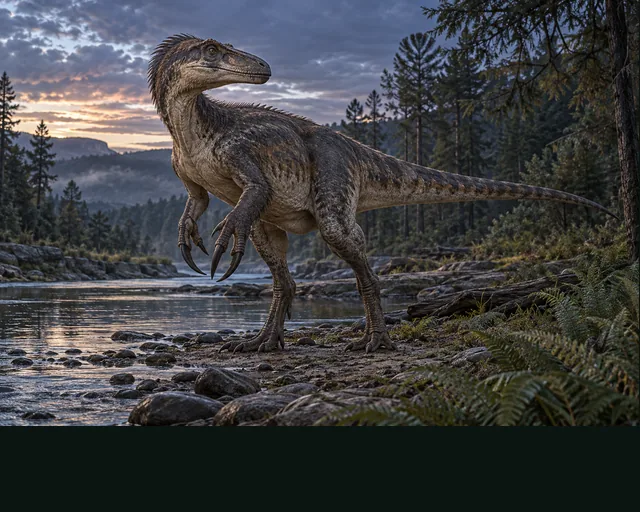
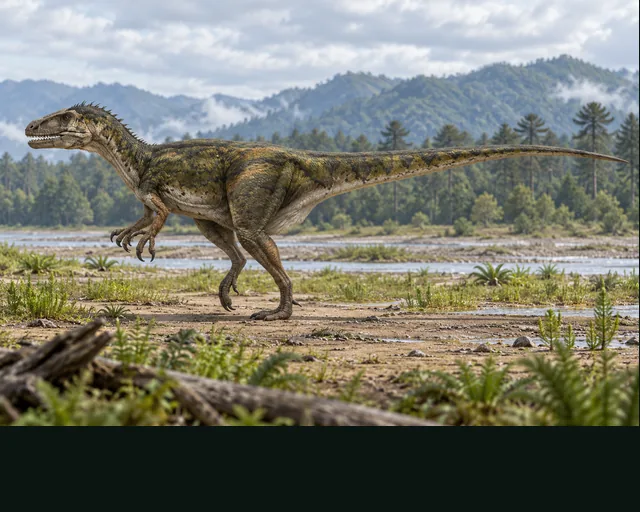
Our illustration follows Atlantis536’s complete artwork, explicitly labelled a speculative megaraptoran reconstruction. Its long low head, grasping arms, powerful hind limbs and long balancing tail follow that reference. The image does not independently establish those missing external structures, a precise size, or a particular prey animal.
Colour, body covering and scenery remain artistic interpretations. The most secure story here concerns the studied bones. Compare Megaraptor and Fukuiraptor, or browse A–Z under A.
Quick answers
- Where did Aoniraptor come from?
- The Late Cretaceous Huincul Formation of Río Negro, Patagonia, Argentina.
- What does pneumatic bone mean?
- Bone invaded by air-filled extensions associated with an air-sac system, rather than merely any hollow bone.
- Which tail structures were unusual?
- The 2020 study identified pneumaticity in chevrons, bones beneath tail vertebrae.
- Is the whole-animal image certain?
- No. The reference explicitly restores it speculatively as a megaraptoran; much external anatomy is missing.