Jurassic Dinos editorial · Updated · Source-based review
Anteavis was an early theropod dinosaur from the Late Triassic of Argentina. Although its name sounds bird-related, it was not a bird. Its importance comes from a surprising mixture of anatomical features that helps researchers investigate the first major diversification of dinosaurs.
An early dinosaur landscape
Ricardo Martínez and colleagues described Anteavis crurilongus in 2025. Its fossils come from the Ischigualasto Formation in northwestern Argentina, a rock sequence famous for preserving early dinosaurs alongside many other prehistoric vertebrates. The study placed Anteavis in the Carnian, an early part of the Late Triassic.
A formation records a sequence of environments through time. It should not be imagined as one crowded scene in which every fossil species lived together on the same afternoon. The researchers used the positions of finds within the rocks to investigate changes in dinosaur diversity and abundance.
A surprising combination
The original analysis placed Anteavis outside Neotheropoda, a major theropod branch. Yet the animal possessed traits previously thought to belong only to that branch. This combination is useful because it suggests that the appearance of such characters was more complicated than a simple checklist acquired one step at a time.
An early-diverging animal is not a half-finished version of a later dinosaur. It was a complete animal with its own anatomy. Nor does sharing a feature prove that one fossil individual was the direct ancestor of another species.
Climate and the fossil record
The study also compared the broader Ischigualasto record with environmental changes. It proposed that regional dinosaur diversification and a later gap in their record were associated with shifts between drier and more humid conditions. That is a regional interpretation based on the available sequence, not proof that all dinosaurs disappeared everywhere at once.
A missing interval in a fossil record can raise several questions. Were the animals absent, were suitable sediments not deposited, or have their remains simply not been found? Geological context helps researchers investigate those alternatives.
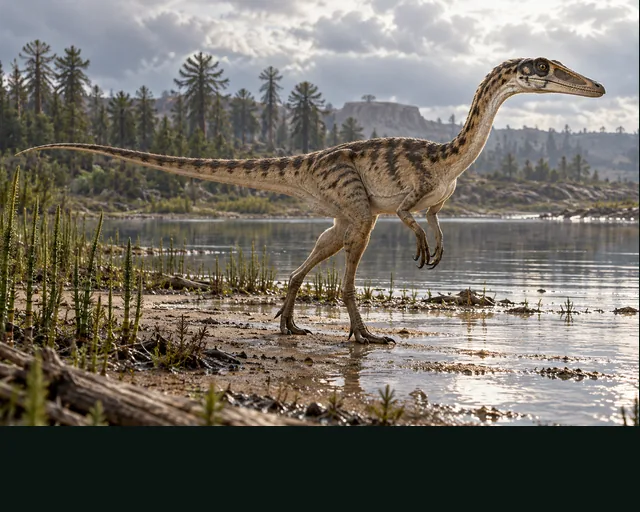
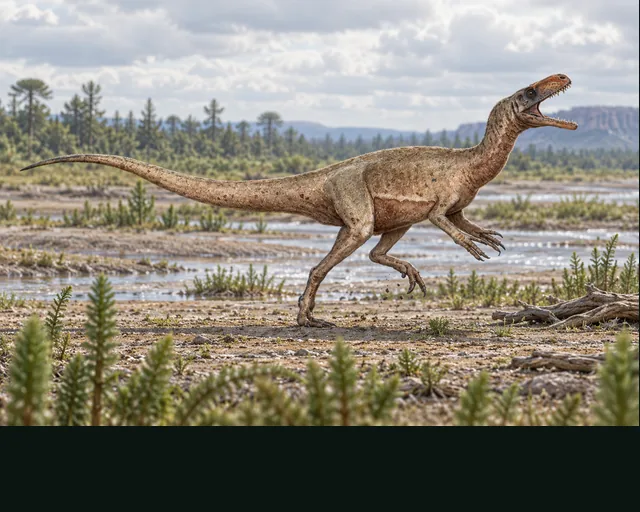
Why does the picture have a feathered covering?
Our image follows Connor Ashbridge’s reviewed complete Anteavis restoration. It retains the small low head, slender neck, short forelimbs, long legs and tapering tail shown in that work. The source artist’s filamentous covering, colours and full-body proportions are interpretations. They are not a claim that this specimen preserved a complete feather coat.
The picture supplies a labelled artistic possibility while the text keeps the fossil evidence separate. Compare Eodromaeus and Coelophysis, or continue through A–Z under A.
Quick answers
- Was Anteavis a bird?
- No. The original study interpreted it as an early-diverging non-avian theropod.
- Where did it live?
- In the Late Triassic landscape represented by the Ischigualasto Formation of Argentina.
- Why were its features surprising?
- It combined an early branching position with traits previously associated with Neotheropoda.
- Does the feathered artwork prove preserved feathers?
- No. The covering follows a complete artist restoration and is explicitly speculative.