Jurassic Dinos editorial · Updated · Source-based review
How could one small jaw fill a gap in a dinosaur community?
Ampelognathus was a small plant-eating ornithopod from what is now North Texas. Tykoski, Contreras and Noto described Ampelognathus coheni in 2023 from a mostly complete left dentary, a bone in the lower jaw. The fossil comes from the Lewisville Formation and is held in the Perot Museum’s collections.
This formation preserves a diverse terrestrial fauna from the early part of the Late Cretaceous. Small ornithischian dinosaurs had been notably difficult to identify in the record. The jaw helped document an expected but previously missing part of that community.
What makes the jaw distinctive?
The original paper compared its proportions, tooth count and the shape of the front of the jaw with those of other small ornithopods. One distinguishing feature is a twist that directs some front tooth sockets partly outward as well as upward. This is a feature of the actual jaw, not a pattern inferred from the completed illustration.
A tooth socket is the space in a jaw where a tooth is held. Comparing these sockets and the surrounding bone can reveal differences even when the teeth themselves are incomplete. The researchers used a combination of features rather than one superficial resemblance.
Where did it live in ancient North America?
The fossil was found near Grapevine Lake in the middle-Cenomanian Lewisville Formation. At that time, a great inland seaway divided much of North America. The paper discusses the region as part of southwestern Appalachia, the eastern landmass, rather than the western landmass called Laramidia.
These ancient geographical names do not match modern state boundaries. They help researchers describe connections between fossil communities before today’s coastlines and landscapes existed.
Is its exact family-tree position settled?
The study recognised it as a non-iguanodontian ornithopod, but its more precise position had weak support in the analysis. Limited jaw material does not preserve all the characters used to compare complete skeletons. More associated fossils could improve that test.
It was a plant eater, but the jaw does not establish every plant it ate or a precise complete adult body size. We do not turn an artistic size estimate into a measured skeleton.
What is reconstructed in the picture?
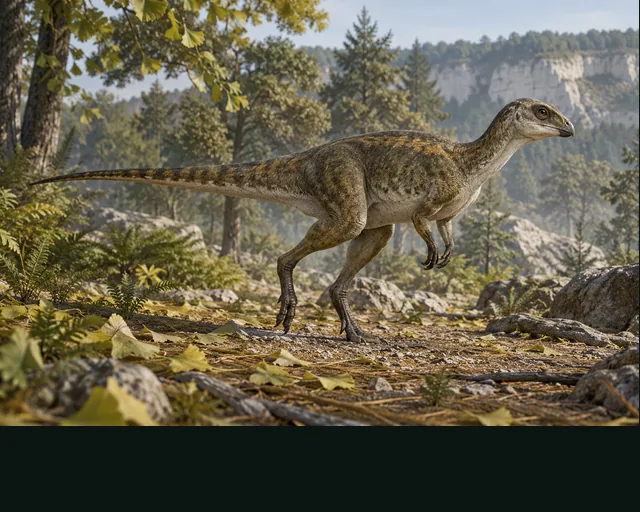
Our artwork follows TotalDino’s complete, named Ampelognathus restoration. The short beaked head, small bipedal body and long tail follow that reference. The jaw-based discovery does not directly preserve its entire body, skin, colour or covering, so those features remain interpretive.
Compare Hypsilophodon and Dryosaurus, or use the A–Z directory under A.
Quick answers
- What fossil identifies Ampelognathus?
- A mostly complete left dentary, part of the lower jaw.
- What is unusual about its front tooth sockets?
- A twist directs some anterior sockets partly outward as well as upward.
- Was it from eastern or western ancient North America?
- The study places its Texas region in southwestern Appalachia, the eastern landmass.
- Does the jaw preserve its whole body size?
- No. Complete proportions, covering and precise adult size remain reconstructed.