Jurassic Dinos editorial · Updated · Source-based review
What was Amazonsaurus?
Amazonsaurus was a plant-eating sauropod from Early Cretaceous northern Brazil. Carvalho, Avilla and Salgado described Amazonsaurus maranhensis in 2003 from the Itapecuru Formation of Maranhão. It adds a named dinosaur to a region whose fossil record is less familiar to many readers than the famous Patagonian localities farther south.
The original paper identified it as a diplodocoid, a member of the broad sauropod branch that also includes Diplodocus and rebbachisaurids. That relationship does not make its body a miniature copy of any one better-known genus.
Which parts of the animal are preserved?
The fossils include vertebrae from the back and tail, ribs and pelvic elements. The university collection’s type inventory records the individual pieces. The original paper describes an incomplete but diagnostic skeleton behind the head, not a complete living outline.
Some distinguishing features concern the ridges and connections on tail vertebrae. These details help researchers compare sauropods even when the complete neck, limbs or skull are unavailable. A useful diagnosis does not require every bone, but missing parts still limit the questions that can be answered.
Does a complete museum reconstruction mean a complete fossil was found?
No. The Universidade Federal do Rio de Janeiro lists a reconstructed Amazonsaurus skeleton in its exhibition. A reconstruction is an educational interpretation that combines preserved evidence with carefully identified restored portions. It is not a claim that the entire animal was excavated intact.
That distinction is especially important when looking at a full-body picture online. An attractive complete outline can be useful for imagining scale and posture, while still containing many features not directly preserved in the original material.
How large was it?
The university exhibition record gives an approximate reconstructed length of ten metres. This is an exhibit estimate, not a measurement of a complete individual. We retain that attribution and leave precise comparison measurements unset pending independently checked numerical evidence.
Its sauropod relationships support a plant-eating interpretation. The reviewed sources do not establish exactly which plants it selected or demonstrate a particular feeding height. We do not calculate those details from the artistic neck position.
What does our image use as a reference?
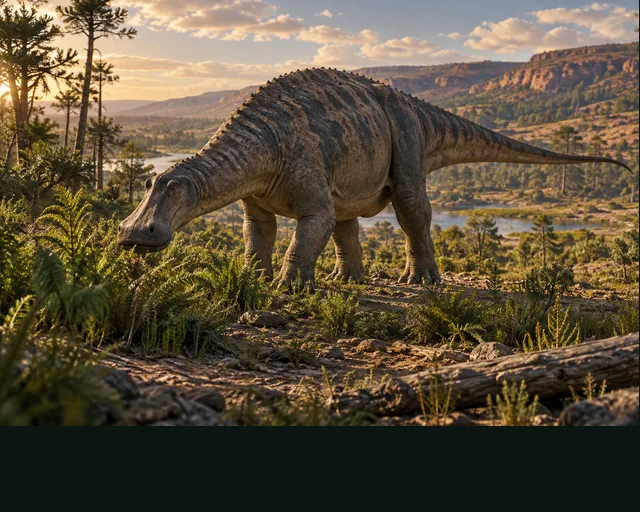
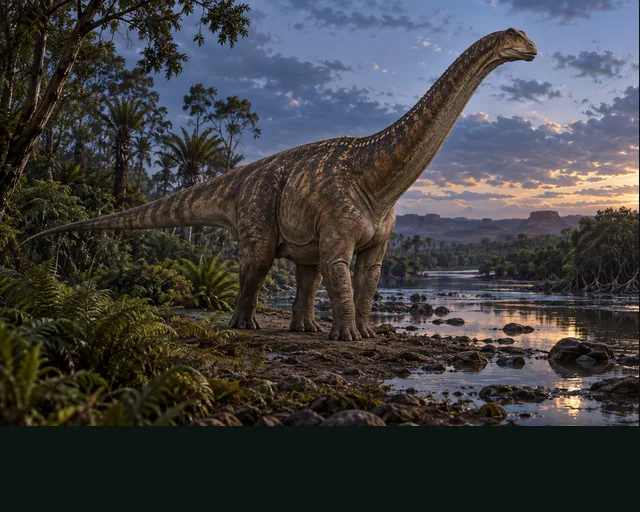
The artwork follows DarkWerewolf’s complete restoration explicitly named Amazonsaurus. The artist identifies comparative reconstruction of missing regions. The long low neck, broad body and slender tail follow that existing full-body image; our production does not derive a fresh animal from vertebral photographs or the museum’s skeletal display. Skin, colours and complete proportions remain interpretive.
Compare Nigersaurus and Rebbachisaurus, or browse the A–Z directory under A.
Quick answers
- Where did Amazonsaurus live?
- Its fossils come from the Early Cretaceous Itapecuru Formation of Maranhão, northern Brazil.
- Was the whole animal found?
- No. The diagnostic fossil material is an incomplete postcranial skeleton.
- Does a complete museum mount imply a complete fossil?
- No. A mount can include reconstructed missing portions.
- Is its length an exact measurement?
- The university exhibition's roughly ten-metre figure is a reconstructed estimate, not a complete measured animal.