Jurassic Dinos editorial · Updated · Source-based review
What kind of dinosaur was Almas?
Almas was a small troodontid theropod from Late Cretaceous Mongolia. Pei and colleagues described Almas ukhaa in 2017 from a skull, lower jaw and partial skeleton found at Ukhaa Tolgod in the Djadokhta Formation. Its name refers to a wild figure in Mongolian mythology; it does not imply that this dinosaur was a snow-dwelling monster.
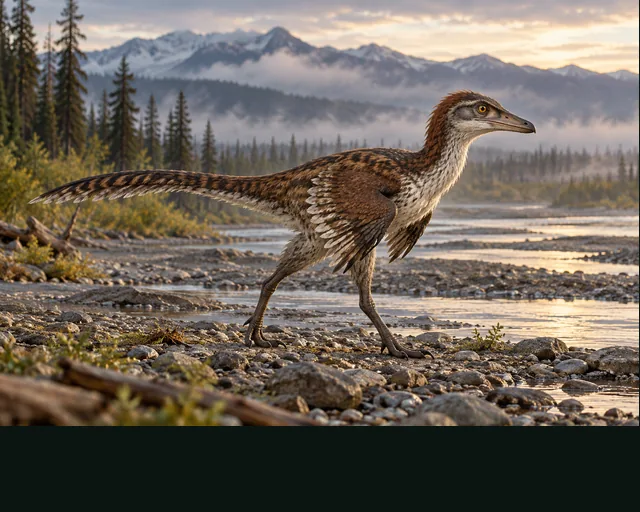
The fossil preserves much more of the head than some other fragmentary troodontids. Nevertheless, it is not a complete adult animal. The distinction matters when interpreting its size and the reconstructed body shown in an illustration.
How did scientists recognise it?
The original description identified a combination of skull, jaw and other skeletal features. Almas had a relatively short snout and small body, while also sharing features with other Late Cretaceous troodontids. Scientists compared individual bones and their relationships rather than simply matching the whole animal to a familiar picture.
The study also revised some earlier ideas about other young troodontid specimens. That is a reminder that discovering a new animal can improve comparisons beyond the new species itself. A better specimen can reveal which features are shared and which are more distinctive.
Was the individual fully grown?
Its growth stage was not straightforward to determine. The original study reported signs of immaturity in several parts of the skeleton, while other bones were already joined. Microscopic examination did not supply a clear absolute age because the bone had been altered after burial.
A 2025 study of bone fusion likewise highlighted Almas as an example in which some ankle elements were fused despite other immature features. Fusion is therefore one clue among several. We should not treat one joined bone as a universal certificate of adulthood.
Do nearby eggshell pieces prove it was a parent?
Small eggshell fragments were found around the skeleton and studied in the original paper. Their association is interesting, but it does not by itself prove that this individual laid the eggs, guarded a nest or died while brooding. Those are separate questions requiring additional evidence.
Similarly, its fossils do not preserve a demonstrated food menu. Our account leaves an exact adult body length, mass and daily diet unset rather than calculating them from the artwork.
What is artistic in the picture?
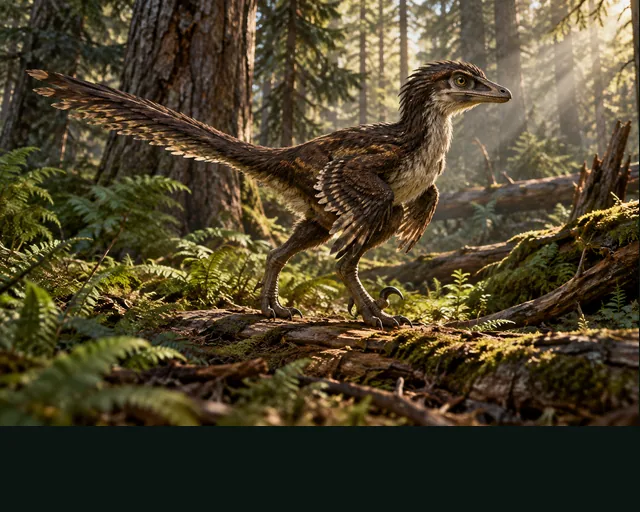
The image follows Tom Parker’s complete Almas restoration, published as Tomopteryx. Its feathered head, forelimbs and long narrow tail follow that named artwork. Feather detail, colours and the complete soft-tissue outline are interpretive, and the image does not establish that the fossil individual had reached adult size.
Compare Saurornithoides and Saurornitholestes, or browse the A–Z directory under A.
Quick answers
- Where did Almas live?
- Its defining fossil comes from Ukhaa Tolgod in Mongolia's Djadokhta Formation.
- Was the individual certainly fully grown?
- No. It combines immature and more developed features, and altered bone tissue did not reveal a clear absolute age.
- Do nearby eggshell fragments prove it was brooding?
- No. Association alone does not show who laid the eggs or what the individual was doing.
- Does the name mean it lived in snow?
- No. The mythological name does not establish its habitat or climate.