Jurassic Dinos editorial · Updated · Source-based review
Why study a dinosaur smaller than a person?
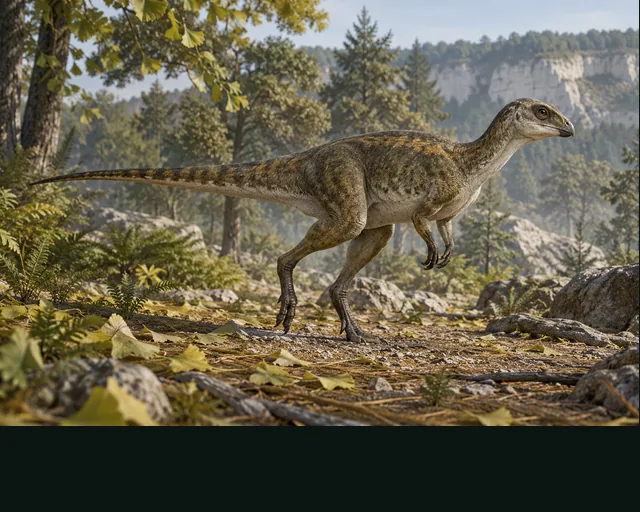
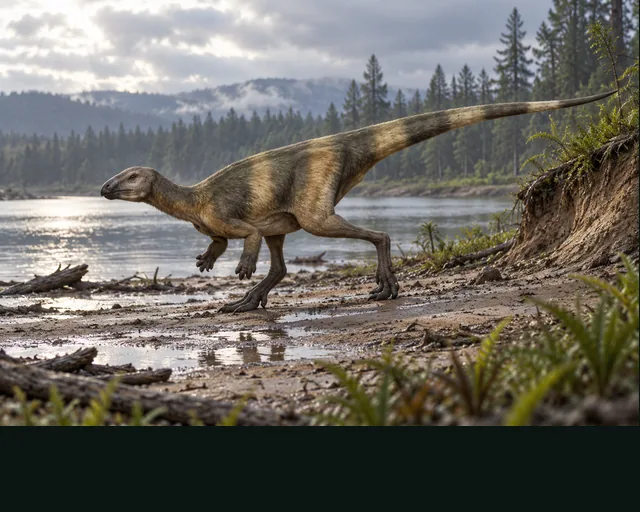
Albertadromeus was a small plant-eating dinosaur from Late Cretaceous southern Alberta. Its discovery helped reveal a part of dinosaur communities that is easy to overlook when museum halls are dominated by giants. The 2013 research team’s announcement compared its estimated size with a large turkey.
The fossils include an incomplete hind limb and other skeletal elements. These were enough for researchers to recognise distinctive anatomy and establish Albertadromeus syntarsus. A complete skull-to-tail skeleton was not required to show that the remains represented something scientifically useful.
What does “Alberta runner” mean?
The genus name refers to Alberta and running. The research announcement connects the species name with fused lower-leg bones. Long, lightly built legs and the particular arrangement of the lower limb supported an interpretation of an animal adapted for running.
That is different from knowing its maximum speed. A fossil limb is not a stopwatch, and estimates require assumptions about muscles, body mass and movement. We do not assign Albertadromeus a precise racing speed or claim that it always escaped every predator.
When was it discovered?
David Evans found the material in 2009 during a collaborative research programme in southern Alberta. Brown and colleagues described it in 2013. The Royal Ontario Museum lists Albertadromeus among the results of its Southern Alberta Dinosaur Project.
The research programme matters because systematic fieldwork can find animals missed by a search focused mainly on large skeletons. A tiny, broken bone needs careful collection and comparison to become part of a useful specimen rather than an unidentified scrap.
Why are small dinosaurs harder to find?
The team’s announcement explains that small bones are particularly vulnerable to destruction before and during fossilisation. They can also be harder for collectors to locate and identify. This creates a preservation and collection bias: the fossil sample does not necessarily contain animals in the same proportions as the living community.
Imagine counting a mixed collection of objects after the fragile ones have broken and been discarded. The sturdy objects may look more common even if they were not originally dominant. Albertadromeus helps scientists investigate a similar problem in ancient ecosystems.
What is certain about the picture?
The image follows Nobu Tamura’s complete restoration specifically published as Albertadromeus syntarsus. The artist explains that the missing body outline draws on comparative reconstruction. We use that already complete named artwork; we do not substitute a separate image of a relative or assemble a new body from the leg bones. Skin, colours and the precise head remain interpretive.
Explore Oryctodromeus and Hypsilophodon, or return to the A–Z directory under A.
Quick answers
- Was Albertadromeus a meat eater?
- The research team's announcement identifies it as a small plant eater.
- Does its name imply an exact speed?
- No. Running-related limb features do not provide a measured maximum speed.
- When was it found and named?
- David Evans found the material in 2009; Brown and colleagues described it in 2013.
- Why are small dinosaur skeletons rare?
- Delicate bones are more easily destroyed, and small remains can be harder to find and identify.