Jurassic Dinos editorial · Updated · Source-based review
Why is Albalophosaurus difficult to place?
Albalophosaurus was an ornithischian dinosaur from Early Cretaceous Japan. The known specimen includes an incomplete skull and lower jaw from the Kuwajima Formation. Its teeth and jaw bones combine features that made it interesting to scientists studying the early history of several plant-eating dinosaur groups.
Ohashi and Barrett described Albalophosaurus yamaguchiorum in 2009. Their analysis placed it near the early branches of Ceratopsia, but they also stressed that this result had weak support. They recommended a broader, uncertain position within Cerapoda until more material became available.
What does an uncertain classification mean?
Cerapoda is a wider ornithischian grouping than Ceratopsia. Saying that an animal’s exact position is uncertain does not mean its fossils are imaginary or that it has no identifiable features. It means that the available comparisons do not yet settle which branch best fits it.
Think of sorting torn pages from several similar books. You may recognise the collection without knowing which volume one page belongs to. Finding a page with more distinctive information can change the result. In dinosaur research, new specimens and revised anatomical comparisons play that role.
The original paper identified a distinctive combination of features in the upper jaw, lower jaw and teeth. It did not identify an unambiguous set of ceratopsian features in the available material. We therefore avoid presenting one narrow family-tree position as certain.
Where does it fit in Japan’s dinosaur history?
The discovery added to the evidence that East Asian dinosaur communities contained more variety than a few famous large species suggest. The taxonomic treatment and original paper document a named animal from central Japan’s Early Cretaceous record, rather than an unnamed generic dinosaur from the whole continent.
A formation is a named package of rock layers. It gives the fossil a geological address, but it does not guarantee that every fossil listed from a broad regional rock group lived at precisely the same time or in the same habitat.
What can we say about its food and size?
The teeth are important evidence for comparing its feeding anatomy. They do not preserve a full daily menu. We also lack a complete skeleton for a securely measured adult length or mass. Those comparison fields remain unset.
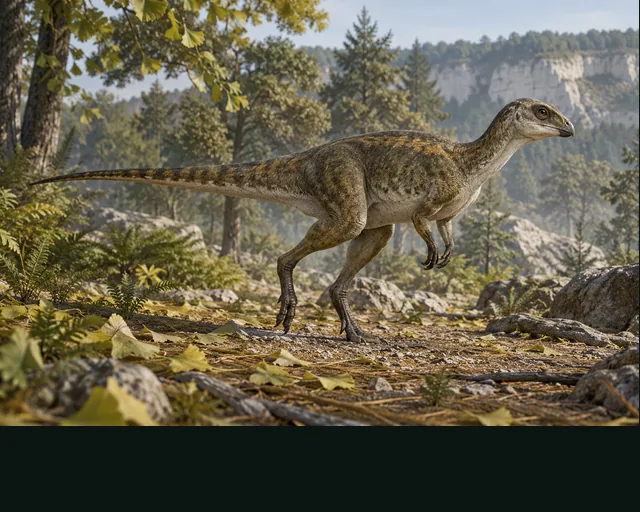
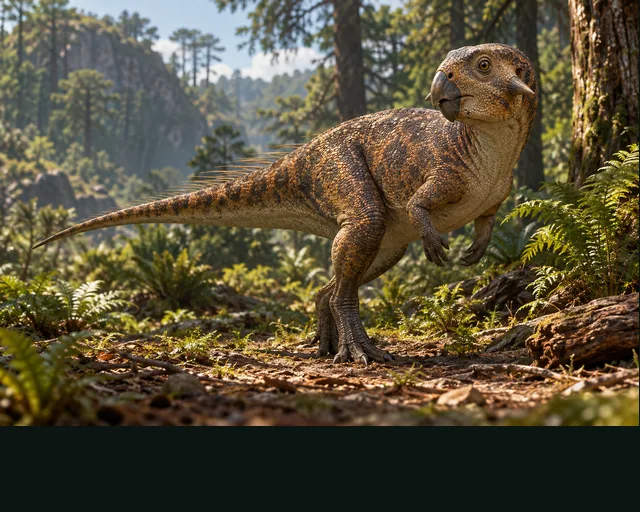
Why does the picture show a complete animal?
Our image follows TotalDino’s full restoration explicitly labelled Albalophosaurus. Its short beaked head, small bipedal body and pointed tail follow that artistic reference. Cranial ornament, body covering, proportions and colours should not be mistaken for features all preserved on the known specimen.
Explore Psittacosaurus and Hypsilophodon, then use the A–Z directory under A.
Quick answers
- Where was Albalophosaurus found?
- It was described from incomplete skull and jaw material in central Japan's Kuwajima Formation.
- Is its exact classification certain?
- No. The original paper's ceratopsian placement had weak support and was explicitly qualified.
- Does uncertainty mean the name is invalid?
- No. Uncertainty about a family-tree branch differs from whether a named fossil has distinguishing features.
- Is the entire body preserved?
- No. The complete appearance follows the named artistic reference, including interpretive proportions and covering.