Jurassic Dinos editorial · Updated · Source-based review
How much can one skull fragment tell us?
Alaskacephale was a pachycephalosaurid dinosaur from Late Cretaceous Alaska. Its defining evidence is a skull fragment centred on the squamosal, a bone near the rear of the head. We do not have a complete animal, or even a complete dome, to measure from nose to tail.
The fragment is valuable because its surface carries a distinctive arrangement of bony nodes. In his 2006 taxonomic review, Robert Sullivan distinguished Alaskacephale gangloffi by two diverging rows of these projections. Their arrangement, rather than a complete cartoon-like dome, provides important evidence for recognising the animal.
Why was it given a separate name?
Gangloff and colleagues had described the Alaskan pachycephalosaur material in 2005. Sullivan’s later review reassessed its similarities and differences and introduced the name Alaskacephale. These publications illustrate two stages of research: recognising a fossil’s broader relationships and deciding whether its preserved features justify a distinct genus.
A small fragment does not automatically mean a useless fossil. Equally, a distinctive fragment does not reveal every missing body part. Researchers must be clear about both conclusions. A diagnostic feature identifies a taxon; it does not provide a complete life history.
Was Alaska always a frozen dinosaur desert?
The material comes from the Prince Creek Formation in northern Alaska. The 2005 paper discussed its significance for the ancient Arctic distribution of pachycephalosaurs. That geographical evidence is important, but the word Arctic should not invite us to paste a modern snowy landscape onto every dinosaur scene.
We cannot determine this individual’s seasonal movements, winter behaviour or insulation from the skull fragment. Claims that it migrated a particular distance or wore a certain coat would need their own evidence. The same caution applies to its skin colour.
Did it use its head for fighting?
Head use is an interesting question for pachycephalosaurs generally, but the Alaskacephale specimen does not preserve a complete dome and body with which to test a particular combat technique. Our page therefore does not describe head-to-head battles as an observed behaviour of this genus.
Its exact adult length, mass and daily food choices are also left uncertain. Comparisons with better-known relatives can help researchers frame hypotheses, but those relatives are not additional Alaskacephale specimens.
What does the illustration represent?
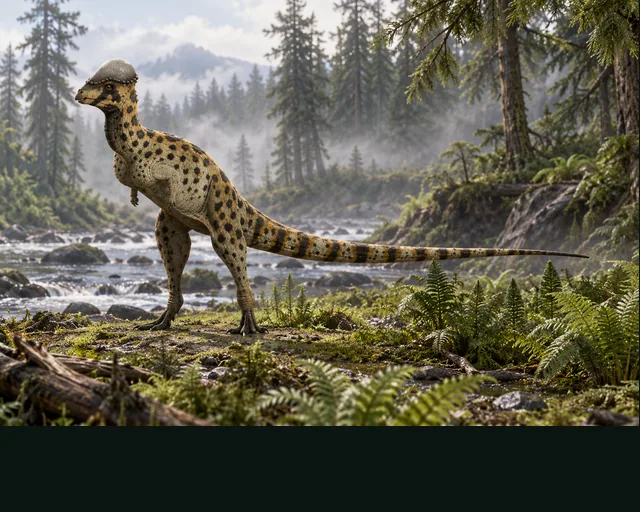
The picture follows Connor Ashbridge’s complete restoration explicitly named Alaskacephale gangloffi. The rounded domed head, short arms, strong hind legs and long tail come from that full-body reference. They are an artistic reconstruction around limited evidence, not a body newly assembled here from the fossil.
Compare Pachycephalosaurus and Colepiocephale, or browse the A–Z directory under A.
Quick answers
- Is a complete Alaskacephale skeleton known?
- The defining evidence is a skull fragment, chiefly the squamosal; a complete body and dome are not preserved.
- What distinguishes its skull fragment?
- Sullivan identified two diverging rows of bony nodes on the squamosal.
- Where did it live?
- Its material comes from the Prince Creek Formation of northern Alaska.
- Is head-butting behaviour established?
- No. The available fragment does not establish a particular combat technique.