Jurassic Dinos editorial · Updated · Source-based review
What was Colepiocephale?
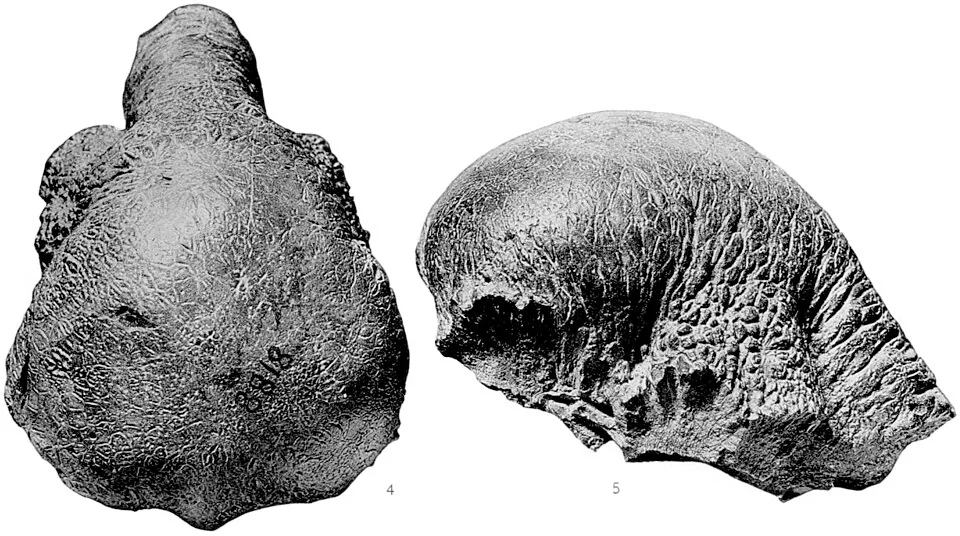
Colepiocephale was a dome-headed dinosaur from Late Cretaceous Alberta. It belongs to the pachycephalosaurs, whose thickened skull roofs are among their most recognisable features. Much of what distinguishes this genus concerns the shape and margins of the preserved skull roof.
What makes the fossil distinctive?
The known dome does not preserve a complete animal. Researchers compare its surface, edges and adjoining bones with other pachycephalosaurs. Small differences may be informative, but growth and individual variation must also be considered before declaring a separate genus.
Where was it found and how was it named?
The species was first described in 1945 as Stegoceras lambei. In 2003 it was placed in the separate genus Colepiocephale. The relevant fossils are associated with the Foremost Formation. Changes in naming and rock terminology explain why older summaries can look different from newer ones.
What can we infer, and what remains uncertain?
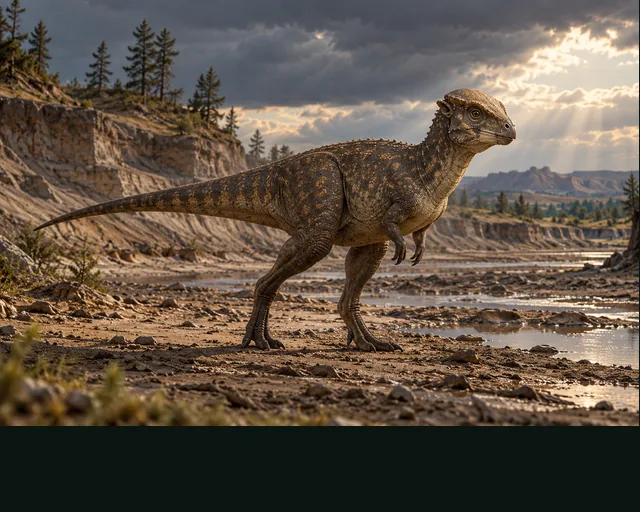
A thick skull invites questions about head-butting, display and defence. Those are behavioural hypotheses, not activities directly recorded by this particular dome. Bone structure, injuries and mechanical modelling can help test them. A careful illustration can show the preserved shape while leaving the animal’s exact actions and soft-tissue colours uncertain.
Does the dome prove that Colepiocephale head-butted rivals?
No. The dome is anatomical evidence. Testing head-butting requires additional evidence about structure, injury and mechanical performance.
How can you check the evidence?
The Paleobiology Database record catalogues Colepiocephale under Pachycephalosauridae. Its linked bibliography identifies this research starting point: R. M. Sullivan. 2003. Revision of the dinosaur Stegoceras Lambe (Ornithischia, Pachycephalosauridae). Journal of Vertebrate Paleontology 23(1):181-207. Open the bibliographic record. A catalogue entry establishes the source trail; it does not independently verify every later illustration or behavioural claim.
Use the dated genus overview to follow the references behind the discovery and anatomy discussed above. When sources disagree, compare which specimen and rock layer each author studied. A reconstructed whole animal can combine original bones with comparisons to relatives; those two kinds of evidence should not be confused. The account above explains the particular limits that matter for Colepiocephale, rather than supplying unsupported size, speed or lifespan figures.
Read the image and keep exploring
Two views of the Colepiocephale skull dome show the limited but informative cranial material on which comparisons depend. A displayed specimen or skeletal mount can include restored parts. Its appearance should be read alongside the original specimen description.
Compare Pachycephalosaurus, Homalocephale. Find more names in the C index and explore ornithischian field notes. The glossary explains unfamiliar fossil terms.
Quick answers
- Where have Colepiocephale fossils been found?
- The discoveries discussed here come from Canada. Modern place names describe discovery locations, not a complete ancient geographic range.
- When did Colepiocephale live?
- It is placed in the Cretaceous period. See the discovery discussion for qualifications about the particular rock layers and dating.
- Where can I compare Colepiocephale with related dinosaurs?
- Follow the related field notes below. Comparisons explain shared anatomy; they do not imply that all the animals lived together.