Jurassic Dinos editorial · Updated · Source-based review
Is every horned dinosaur covered in horns?
Ajkaceratops was a plant-eating dinosaur from Late Cretaceous Hungary. Its name places it in the story of ceratopsians, the group that includes Triceratops. Yet it did not have to look like that famous North American animal. A group name is not a checklist requiring every member to display the same spectacular ornaments.
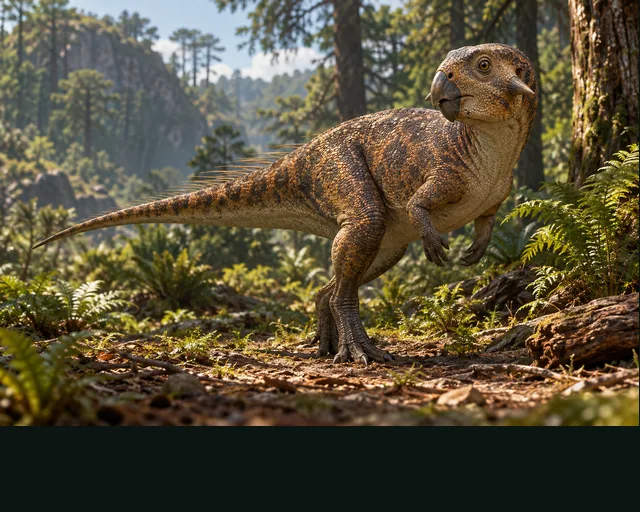
The complete restoration used for our artwork shows a deep beaked head, a sturdy low body and a long tail, without the large horns and towering frill familiar from ceratopsids. Those visible features follow the named reference, rather than a generic horned-dinosaur design.
Why was its identity debated?
Ajkaceratops kozmai was first described in 2010 from fragmentary material. With limited overlap between specimens, researchers disagreed over what its unusual anatomy meant. Identifying an animal from only part of the face is difficult when different dinosaur groups can evolve some similar features.
New research published in 2026 described more informative skull material and supported a ceratopsian identity. The study also proposed that material previously called Mochlodon vorosi belonged to Ajkaceratops. That conclusion changes an identification; it does not add a second animal every time a historical name appears.
Where did it live?
The University of Birmingham’s account places it in the European island landscapes of about 84 million years ago. Hungary’s present-day mountains and towns do not describe the coastline or climate of that time. Large parts of Late Cretaceous Europe formed an archipelago, meaning a collection of islands separated by water.
Island geography matters when scientists ask how dinosaur populations were connected. However, the discovery of one genus does not reveal a complete migration route. Such explanations must also consider geological connections, the ages of fossils and comparisons with animals from other regions.
What can the beak tell us about food?
Its ceratopsian relationships and beaked feeding apparatus support a plant-eating interpretation. They do not reveal every plant it selected or how much it ate each day. We avoid a detailed menu or an exact body mass without evidence that can support those numbers.
How current is the illustration?
Our artwork follows Olmagon’s complete Ajkaceratops restoration, explicitly updated with reference to the 2026 study. The absence of giant ceratopsid-style ornaments follows this visual direction. Colour, soft tissues and the complete outline still involve artistic interpretation; the picture should not be read as a photograph of a fully preserved animal.
Compare the very different Protoceratops and Psittacosaurus, or use the A–Z directory under A.
Quick answers
- Did Ajkaceratops look like Triceratops?
- Its current complete restoration lacks the giant horns and towering frill familiar from North American ceratopsids.
- Where did it live?
- It lived in the Late Cretaceous European island region now represented by Hungary.
- Why did its classification change?
- New skull evidence analysed in the 2026 study supported a ceratopsian identity after earlier debate.
- Does Mochlodon vorosi add another animal here?
- The 2026 study proposed it as a synonym of Ajkaceratops, so it is not counted as a separate animal on this page.