Jurassic Dinos editorial · Updated · Source-based review
How can an old museum fossil become a new dinosaur?
Ahshislesaurus was a large plant-eating hadrosaur, or duck-billed dinosaur, from Late Cretaceous New Mexico. Its scientific name was introduced in 2025, but the defining fossils had been collected more than a century earlier. A new name does not always begin with a new excavation. Sometimes it begins with a second look at a museum collection.
The Smithsonian records the defining specimen as partial skull and jaw material together with neck vertebrae. John B. Reeside Jr. collected it in 1916 from rocks now assigned to the Hunter Wash Member of the Kirtland Formation. Those details connect the specimen to a particular place and geological interval.
Why was it separated from Kritosaurus?
The material had previously been referred to Kritosaurus. Dalman and colleagues compared it again with other hadrosaurs and identified a distinctive combination of skull features. Their 2025 description established Ahshislesaurus wimani rather than continuing to place the specimen under the older identification.
According to the research team’s university account, important comparisons concern bones of the cheek, lower jaw and rear of the skull. Such comparisons are more informative than asking whether two restorations have similar duck-shaped mouths. Closely related animals can share an overall appearance while differing in smaller anatomical details.
Which body fossils certainly belong to it?
The distinction between a defining specimen and additional referred material matters here. Some other bones may belong to Ahshislesaurus, but the authors explained that further overlapping fossils are needed to test those referrals. Finding a large body bone in the same rock unit is not enough, by itself, to establish its identity.
For that reason, the impressive body-size estimates discussed in publicity should not be treated as measurements of a complete, securely associated skeleton. Our comparison fields remain unset rather than turning tentative referrals into precise numbers.
What was its world like?
The fossils belong to the Campanian part of the Late Cretaceous. Hadrosaurs were important plant eaters in western North American ecosystems. The university account describes a local fauna that also included horned dinosaurs, armoured dinosaurs, several theropod groups and numerous smaller vertebrates. Sharing a fauna does not demonstrate that any particular predator attacked this individual.
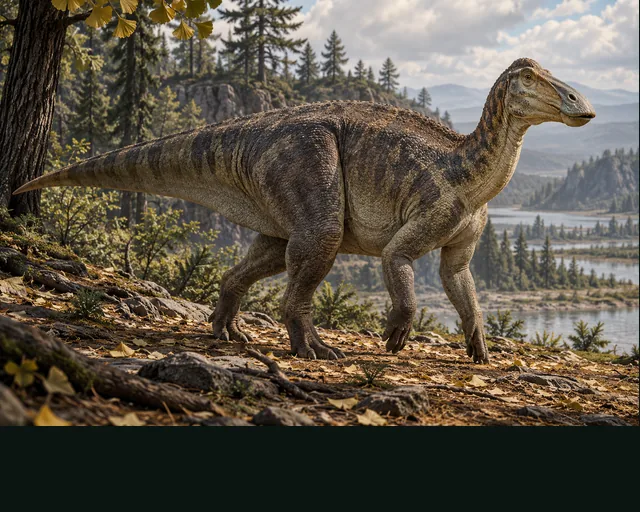
What is reconstructed in the image?
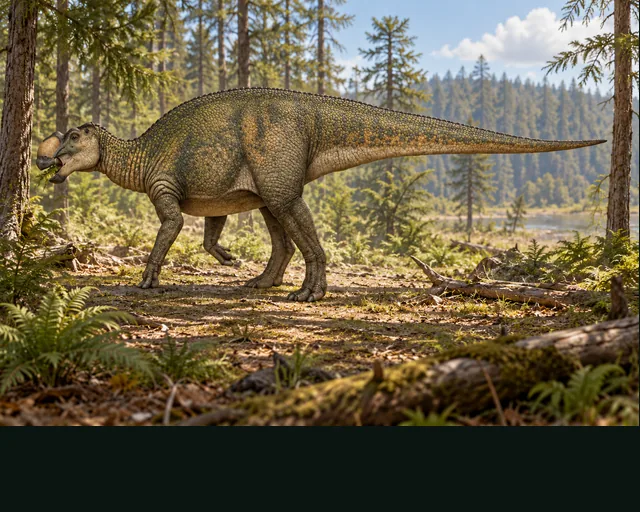
Connor Ashbridge’s complete, named restoration supplies the visual reference for our artwork. The beaked head, deep body and long tail follow that image. Its raised back outline, skin and colours are interpreted features; they are not all directly established by the defining skull and neck material.
Explore Gryposaurus and Edmontosaurus, then return to the A–Z directory under A.
Quick answers
- When was Ahshislesaurus named?
- Dalman and colleagues introduced Ahshislesaurus wimani in 2025.
- Were the fossils newly excavated?
- The defining material was collected in 1916 and had previously been assigned to Kritosaurus.
- Where did it live?
- Its defining specimen comes from the Hunter Wash Member of New Mexico's Kirtland Formation.
- Do all referred body bones certainly belong to it?
- No. The research team's account explains that some referrals need more overlapping material to confirm them.