Jurassic Dinos editorial · Updated · Source-based review
Was Agustinia really covered in giant spines?
Agustinia was a long-necked plant-eating dinosaur from Early Cretaceous Argentina. You may have seen older pictures showing enormous spikes or plates along its back. Those dramatic pictures reflect an interpretation that later research challenged. The evidence for that supposed armour does not hold up under close examination.
This makes Agustinia an interesting example of a changing scientific explanation. The fossil objects did not disappear. Instead, scientists tested whether they had been identified correctly. A shape that looks like a plate on the outside can preserve a different story inside.
What changed the armour interpretation?
Bellardini and Cerda examined the microscopic structure of the supposed armour in a study published in 2017. Their comparisons did not support identifying the pieces as osteoderms, the bones that form within skin in some armoured animals. Several pieces were more consistent with ribs; another poorly preserved piece was tentatively interpreted as part of the pelvis.
Microscopic evidence matters because different bones develop different internal arrangements. Imagine finding an unfamiliar piece of a machine: its outline suggests one purpose, but its connections and internal construction can reveal another. The study did not establish every aspect of Agustinia’s appearance, but it removed the main support for the spectacular armoured-back reconstruction.
Where did it live, and what kind of sauropod was it?
The fossils come from the Lohan Cura Formation at Cerro de los Leones in Neuquén Province, Patagonia. A later anatomical revision, published online in 2022, described material from one individual and recovered Agustinia as an early-diverging rebbachisaurid. Rebbachisaurids belong to the diplodocoid branch of the sauropod family tree.
That placement is a result of comparing combinations of anatomical features. It does not mean Agustinia had exactly the same feeding apparatus or body proportions as every other rebbachisaurid. A family relationship is useful context, not permission to borrow another animal’s complete anatomy.
How big was it, and what did it eat?
Its sauropod relationships support a plant-eating interpretation. The sources reviewed here do not establish a particular daily menu or a securely measured complete adult body. We therefore leave a precise length and mass out of the comparison data.
What does our picture show?
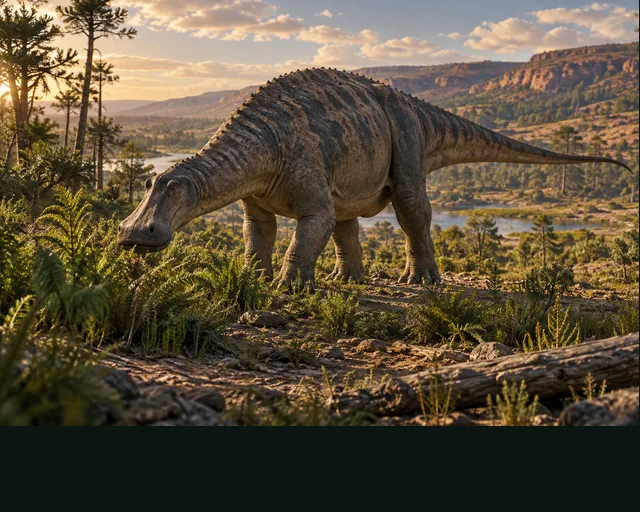
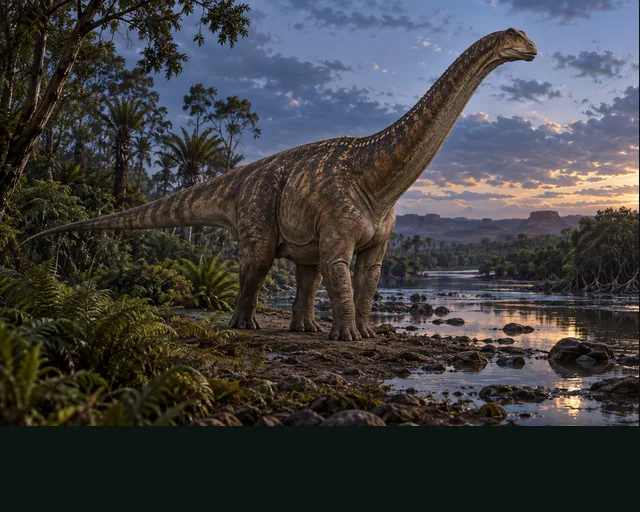
The artwork follows Atlantis536’s complete, explicitly named Agustinia restoration, which cites the later revision. Its low neck, unspined back and long tail follow that reference. Skin, colours and scenery remain artistic choices rather than a preserved view of the living animal.
Compare Nigersaurus and Rebbachisaurus, or explore the A–Z directory under A.
Quick answers
- Did Agustinia have giant armour spikes?
- The 2017 microscopic study did not support interpreting the supposed armour as osteoderms.
- Where was it found?
- Its material comes from the Lohan Cura Formation in Neuquén Province, Patagonia, Argentina.
- What kind of sauropod was it?
- The later revision recovered it as an early-diverging rebbachisaurid.
- Is its exact adult size known?
- The reviewed sources do not establish a complete measured adult body; comparison measurements remain unset.