Jurassic Dinos editorial · Updated · Source-based review
What was Yi?
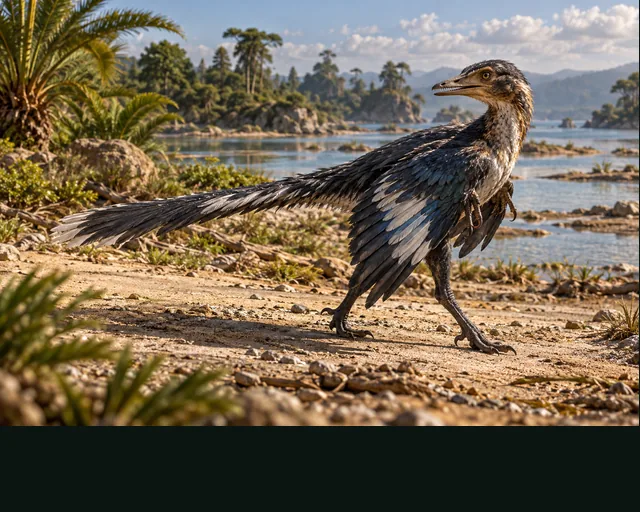
Yi was a tiny Jurassic dinosaur from China with an extraordinary wing design. Its only named species, Yi qi, preserves evidence of a membrane associated with an elongated finger and a long wrist support. The result was different from the familiar feathered wing of a bird.
What makes the fossil distinctive?
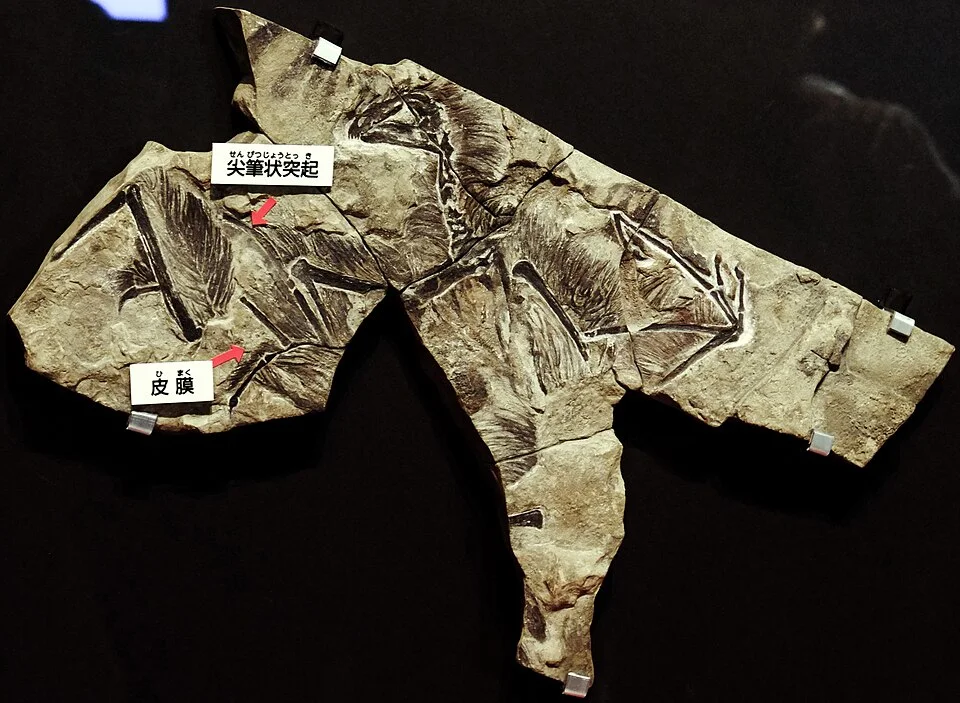
The long rod-like support is called a styliform element. Together with the elongated finger, it helped researchers interpret traces of membrane around the forelimb. Yi also had feathers, so “membrane wing” does not mean a completely featherless animal. Because parts of the skeleton and soft tissues are incomplete, the precise outline and attachment of the living wing require reconstruction.
Where was it found and how was it named?
The specimen came from Hebei and entered the collections of the Shandong Tianyu Museum of Nature. Preparation revealed unusual features, and scanning helped investigate their authenticity. The animal was formally described in 2015. Its short name combines Chinese words meaning wing and strange, an appropriate reminder that the fossil record includes body plans quite unlike those of living animals.
What can we infer, and what remains uncertain?
Membrane wings evolved in other groups, including bats and pterosaurs, but Yi was neither a bat nor a pterosaur. Similar structures can evolve independently when they solve comparable physical problems. Gliding has been proposed for Yi, while the effectiveness and details of its aerial movement remain subjects for analysis. It should not be presented as a demonstrated strong flapping flyer. Comparing Yi with Ambopteryx tests whether this unusual anatomy was an isolated case or part of a wider dinosaur lineage.
Why does Yi matter for the origin of flight?
It documents an alternative dinosaur wing construction. That broadens the evidence beyond bird-like feathered wings without proving that Yi was an ancestor of modern birds.
How can you check the evidence?
The Paleobiology Database record catalogues Yi under Scansoriopterygidae. Its linked bibliography identifies this research starting point: X. Xu, X. Zheng, and C. Sullivan, X. Wang, L. Xing, Y. Wang, X. Zhang, J. K. O.’Connor, F. Zhang, Y. Pan. 2015. A bizarre Jurassic maniraptoran theropod with preserved evidence of membranous wings. Nature 521(7550):70-73. Open the bibliographic record. A catalogue entry establishes the source trail; it does not independently verify every later illustration or behavioural claim.
Use the dated genus overview to follow the references behind the discovery and anatomy discussed above. When sources disagree, compare which specimen and rock layer each author studied. A reconstructed whole animal can combine original bones with comparisons to relatives; those two kinds of evidence should not be confused. The account above explains the particular limits that matter for Yi, rather than supplying unsupported size, speed or lifespan figures.
Read the image and keep exploring
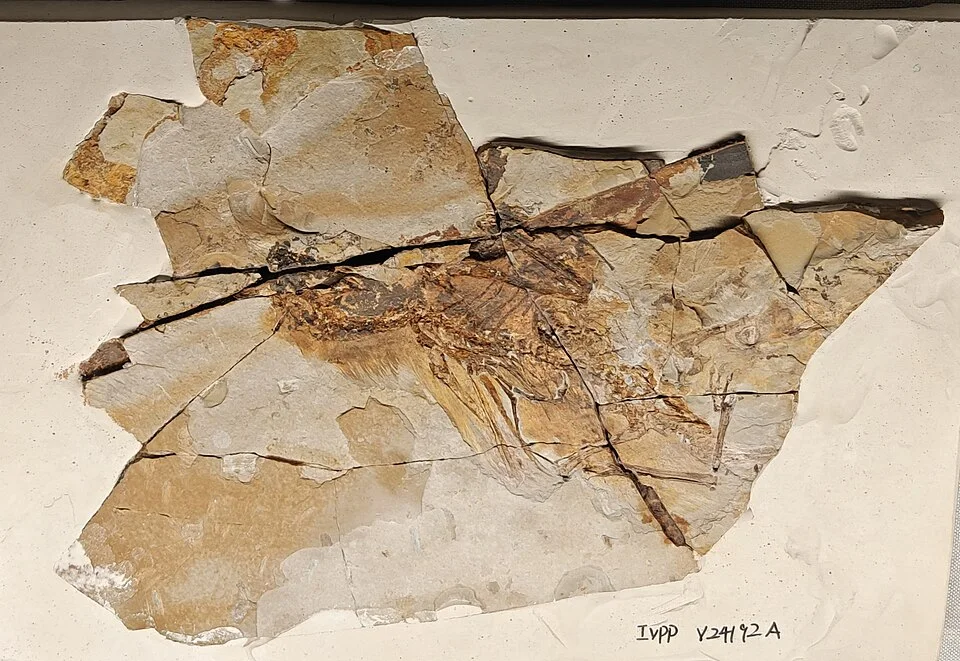
The flattened Yi specimen preserves associated skeletal material, the starting point for interpreting its unusual forelimb anatomy. A displayed specimen or skeletal mount can include restored parts. Its appearance should be read alongside the original specimen description.
Compare Ambopteryx, Archaeopteryx, Microraptor. Find more names in the Y index and explore theropod field notes. The glossary explains unfamiliar fossil terms.
Quick answers
- Where have Yi fossils been found?
- The discoveries discussed here come from China. Modern place names describe discovery locations, not a complete ancient geographic range.
- When did Yi live?
- It is placed in the Jurassic period. See the discovery discussion for qualifications about the particular rock layers and dating.
- Where can I compare Yi with related dinosaurs?
- Follow the related field notes below. Comparisons explain shared anatomy; they do not imply that all the animals lived together.