Jurassic Dinos editorial · Updated · Source-based review
What was Linhevenator?
Linhevenator tani was a bird-like theropod dinosaur belonging to Troodontidae. Researchers described it in 2011 from a partial, partly connected skeleton from the Upper Cretaceous Wulansuhai Formation of Inner Mongolia, China. Its unusual arms and feet made it particularly useful for investigating how different features evolved within the group.
How short were its arms?
The original study identifies a humerus, or upper arm bone, that was proportionately shorter and more robust than those of most other troodontids. Proportionately is the key word: researchers compare an element with other parts of the animal and with corresponding elements in relatives. An isolated short bone does not by itself tell us the total size of the dinosaur.
Relatively short arms also do not mean that the forelimbs had no function. The reviewed evidence concerns their anatomy and evolutionary history; it does not establish a single precise everyday use. Our page therefore avoids inventing a specialised digging, climbing or hunting routine to explain them.
What was unusual about its second toe?
The study describes a specialised second toe resembling the condition found in dromaeosaurids. Scientists call it pedal digit II: pedal refers to the foot, and II is the Roman numeral for two. Similarity in this feature did not make Linhevenator a dromaeosaurid. The researchers placed it within Troodontidae using a broader combination of characters.
They interpreted the specialised toe as an independent development in more derived troodontids. This illustrates why a family tree cannot reliably be built from just one dramatic claw. Similar structures can appear in different branches, and the rest of the anatomy helps distinguish that possibility from inheritance within one narrowly defined group.
What remains uncertain in the picture?
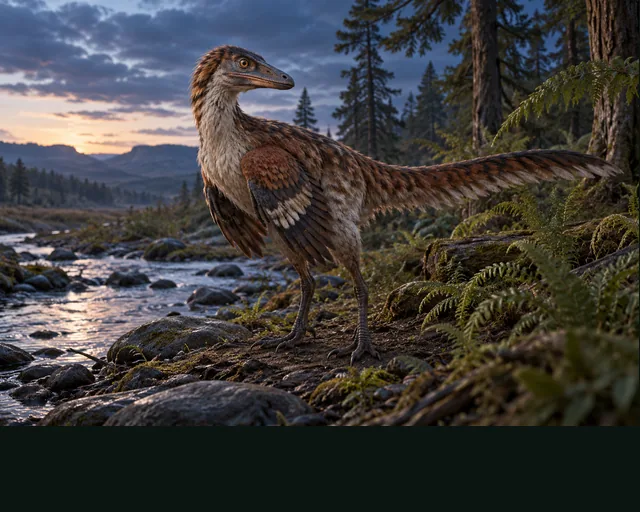
The complete illustration follows the approved named feathered restoration. Notice the compact trunk, short forearms, long hindlegs and narrow tail. Its feather fans, colours and precise stance remain artistic choices. Neither the pose nor the toe claws demonstrate flight, a particular prey species or a directly observed hunting technique.
Compare Byronosaurus and Saurornithoides for other troodontid accounts, then continue through the L directory. Ask which features are shared, which differ and how much of each animal is actually preserved.
Quick answers
- Which dinosaur group includes Linhevenator?
- Troodontidae.
- What was unusual about the arms?
- The upper arm bone was relatively short and robust.
- What is pedal digit II?
- The second toe of the foot.
- Does a similar claw make it a dromaeosaurid?
- No. Researchers assessed its overall anatomical character combination.