Jurassic Dinos editorial · Updated · Source-based review
What was Jinfengopteryx?
Jinfengopteryx elegans is a small, feathered theropod dinosaur from Hebei, China. Described under that name in 2005, it became part of a scientific discussion about how to recognise the relatives of birds. Its bird-like appearance makes that discussion easy to understand, but appearance alone does not settle the answer.
Why did its classification change?
A 2007 comparison treated Jinfengopteryx as an avialan close to Archaeopteryx. A later research discussion noted reassignment by some researchers to the troodontid dinosaurs. Those are different interpretations of relationships, not two different discoveries of a modern bird.
Birds themselves belong within Dinosauria. The more specific question is where an extinct animal fits among the many branches near their origin. Feathers can occur on several such branches, so finding feathers is not enough to place a fossil beside any particular living bird.
What did the anatomical comparison examine?
The 2007 study discusses the head, closely packed teeth, relative forelimb and hindlimb proportions, and the long feathered tail. This is a good example of combining evidence from different body regions instead of making a decision from one feature.
The authors used the idea of mosaic evolution: different parts of a body need not change together or at the same rate. You might find a familiar-looking feathered outline alongside a much less familiar tail or set of teeth. “More bird-like” therefore needs a more precise follow-up question: which structure are we discussing, and which comparison supports it?
Does our picture show its real colours?
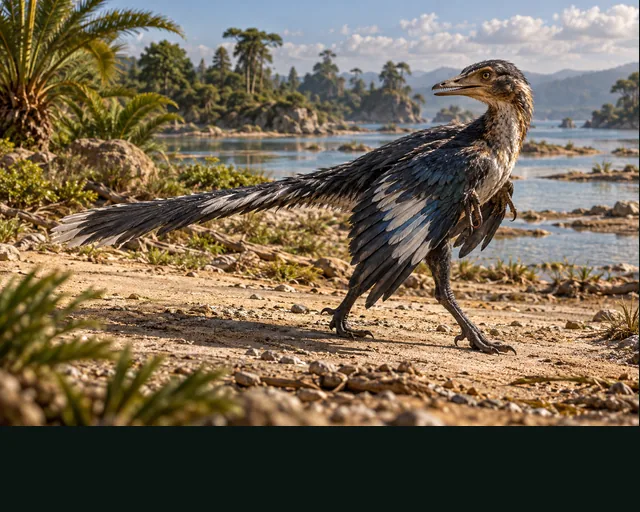
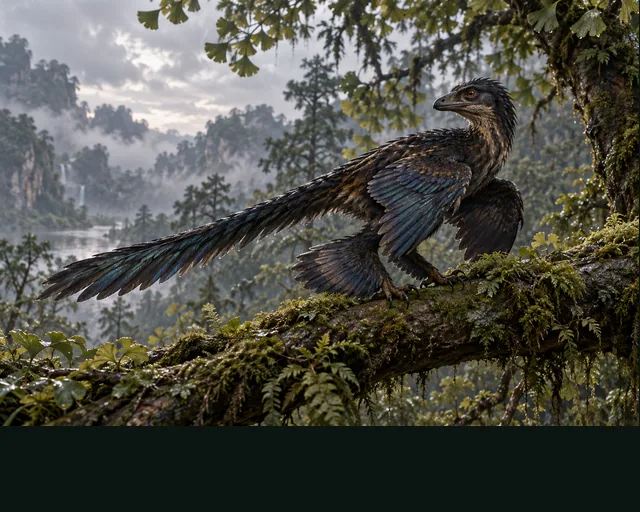
Our complete illustration follows Matt Martyniuk’s explicitly named living reconstruction. Its dark body, golden feather accents, reddish face and long lifted tail make an engaging image, but those colours are artistic choices. The new woodland setting and walking moment are independent composition, not a recovered snapshot of daily life.
The picture also does not demonstrate powered flight. Flight performance is a separate scientific question from having feathers or looking superficially bird-like. Keeping that boundary clear lets a reconstruction remain useful without asking it to prove more than it can.
Read about Archaeopteryx and Microraptor for two other feathered-animal accounts, then continue through names beginning with J. Compare the particular evidence discussed in each one, rather than simply sorting pictures into “bird” and “dinosaur” boxes.
Quick answers
- Where did Jinfengopteryx come from?
- Hebei, China.
- Did it have teeth?
- The published comparison describes closely packed teeth.
- Do feathers alone prove a modern-bird identity?
- No. Relationships require multiple anatomical comparisons.
- Are its golden colours known?
- No. They follow the credited artist’s interpretation.