Jurassic Dinos editorial · Updated · Source-based review
What was Jian changmaensis?
Jian changmaensis is a microraptorine theropod dinosaur described in 2026 from the Early Cretaceous Xiagou Formation near Changma, in northwestern Gansu, China. Its discovery is striking because a very incomplete specimen can still preserve a distinctive anatomical combination.
What did the researchers actually have?
The type specimen, GSGM-D050, consists of a partial left shoulder girdle and forelimb. The wrist and hand are missing. The original description compares the preserved bones to identify the dinosaur; it does not report a complete head, body and feathered tail.
This distinction makes the specimen an interesting scientific puzzle. A missing hand does not make the surviving arm uninformative, just as missing pages do not remove every clue from a damaged document. At the same time, the information in the preserved part cannot answer every question about the whole animal.
Does its name mean it had only one wing?
The genus name alludes to a one-winged bird in Chinese mythology, reflecting both a bird-like dinosaur and the material preserved. The species name refers to Changma. This is a naming story, rather than evidence that the living animal had an unpaired wing.
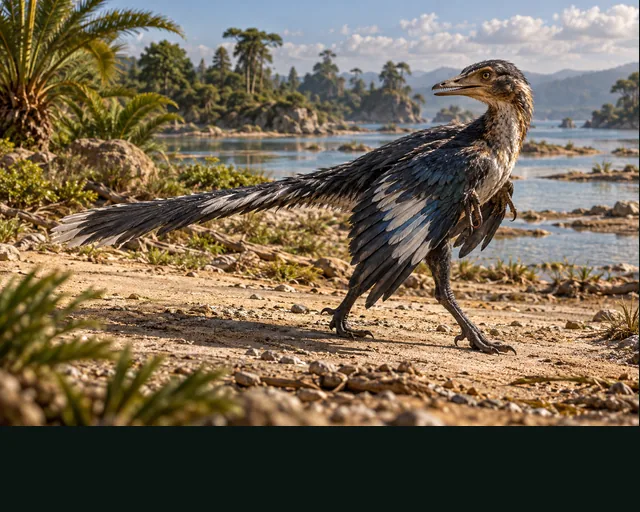
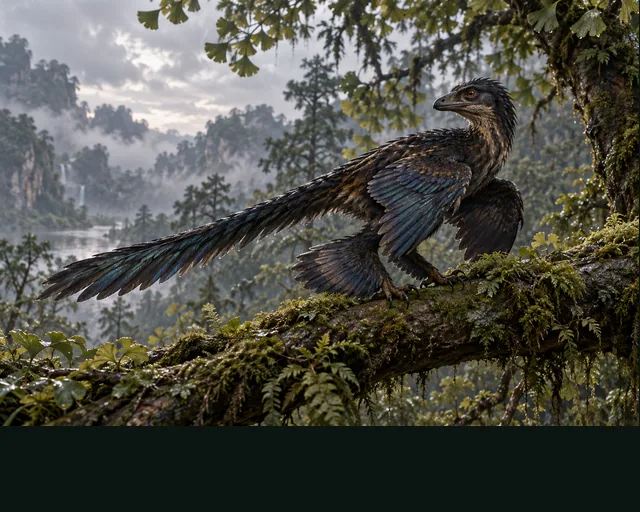
Scientific names can commemorate places, people or stories. Translating a name is therefore useful background, but it is not a substitute for reading the anatomical description. The same caution applies to the restored feathers: a bird-like appearance in an illustration is not, by itself, a test of flying ability.
What made the locality notable?
The original study describes Jian as the first non-avian dinosaur body fossil reported from the Changma Basin’s Xiagou Formation, a setting already famous for bird remains. The claim concerns that formation and basin; it does not mean that no other dinosaur had previously been found anywhere in Gansu or China.
Why show a complete animal here?
Our image follows Connor Ashbridge’s explicitly named, complete Jian reconstruction. It makes the reference’s slim body, folded feathered forelimbs and long tail easy to compare, while keeping their uncertainties visible in the caption. Colour and lakeshore scenery are independent artistic choices.
Read about Microraptor and Archaeopteryx for other accounts near the dinosaur–bird story, or explore more names beginning with J.
Quick answers
- Where was Jian found?
- Changma Basin, Gansu, China.
- Was a whole dinosaur found?
- No; its type material is a partial shoulder and arm.
- Did it have only one wing?
- The name is a mythological allusion, not that anatomical claim.
- Does the illustration prove its plumage?
- No. Missing external features are artistic restoration.