Jurassic Dinos editorial · Updated · Source-based review
What was Graciliceratops?
Graciliceratops was a small plant-eating dinosaur from Late Cretaceous Mongolia. Paul Sereno named the genus in 2000, and its species is Graciliceratops mongoliensis. It belongs to Ceratopsia, the wider evolutionary group that includes the famous horned dinosaurs.
The Natural History Museum records a partial skull and skeleton. Those remains provide more information than a single isolated tooth, but they should not be described as preserving every detail of the living animal.
Why does a small ceratopsian matter?
Large ceratopsids such as Triceratops represent only part of the group’s diversity. Other ceratopsians had much smaller bodies, different limb proportions and less spectacular skull ornaments.
Studying those forms helps researchers investigate how different combinations of features evolved. A group name associated with horned faces does not require every member to display three large horns. Relationships depend on detailed anatomical comparisons rather than a checklist of the most famous animal’s appearance.
Can we use the fossil’s size as the adult size?
Not automatically. A small specimen may represent a young individual, a small-bodied species, or an incomplete animal whose total dimensions need estimating. Growth stage requires evidence beyond the impression that a picture looks youthful.
For that reason, this account does not turn the museum’s approximate small-size description into a precise adult length or mass. A full-body restoration also cannot resolve maturity: an artist must choose proportions even when the fossils do not establish every dimension.
What can a partial skull tell us?
Skull remains allow researchers to compare preserved features with those of other ceratopsians. Missing regions, crushing and restoration all need to be distinguished from original anatomy. The associated body bones add information about the rest of the skeleton, but their incompleteness still limits the comparison.
A diagnosis concerns the characters that can identify a taxon. It is different from a general life portrait, which fills the outline with soft tissues, colour and an environment. Keeping those purposes separate makes both the science and the artwork easier to understand.
Reading our portrait
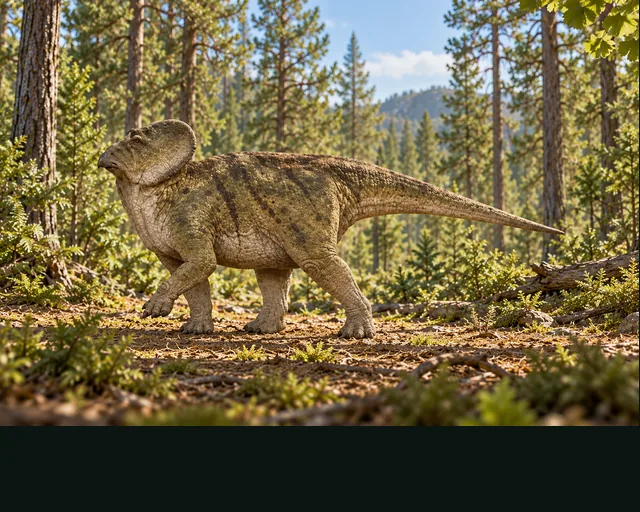
The approved complete reference guided the beaked head, triangular short frill, short forelimbs, long hindlegs and balancing tail. Large brow horns have not been added to make the animal resemble Triceratops.
The striped skin, colour and momentary stance are artistic choices. The picture does not demonstrate a habitual pose, a specific social role or the maximum size of a mature individual.
Compare Protoceratops and Bagaceratops, then browse the G directory.
Quick answers
- Where was Graciliceratops found?
- In Mongolia.
- What kind of dinosaur was it?
- A small ceratopsian, within the wider horned-dinosaur evolutionary group.
- Did it have three huge horns?
- The approved reconstruction does not show Triceratops-style horns.
- Does a tiny specimen prove tiny adults?
- No. Growth stage and missing anatomy must be assessed before assigning adult size.