Jurassic Dinos editorial · Updated · Source-based review
What was Chakisaurus?
Chakisaurus was an ornithopod dinosaur from Patagonia in Argentina. Its species is Chakisaurus nekul, named in 2024. Researchers placed it among elasmarians, a branch of plant-eating ornithischians. Its arm and tail bones provide useful evidence for comparing animals whose complete anatomy is still unevenly known.
Ornithopod does not mean that every member was a huge duckbill. The group includes different sizes and proportions, and an anatomical study can reveal differences that are difficult to recognise from a simple silhouette.
Where were the remains found?
The original account describes material from the Pueblo Blanco Natural Reserve in Río Negro Province, within the Huincul Formation. A formation is a package of rocks, not an individual dinosaur’s age certificate. The date assigned to those rocks can change as researchers obtain new geological evidence.
The 2024 description used an Upper Cretaceous age. A 2026 zircon-dating study instead places the Huincul Formation in the Albian, within the Early Cretaceous. Our broad age label follows that revision; it does not give a false exact age for each fossil.
Why examine the upper arm?
The humerus is the upper-arm bone, between the shoulder and forearm. The study compared its shape with the arms of other elasmarians, noting differences between smaller and larger members of the group.
Such comparisons can help researchers investigate how bodies supported weight and moved. They do not directly measure a living dinosaur’s speed. A name translated with a suggestion of swiftness also cannot replace a biomechanical test or a suitable trackway.
What can the tail contribute?
The authors highlighted how Chakisaurus improves knowledge of elasmarian caudal anatomy. Caudal means related to the tail. Looking at several vertebrae can show a pattern that an isolated bone would miss, making the specimen useful even without an entire living body being preserved.
Similar words in another paper are not interchangeable evidence. A study of a sauropod’s tail should not be used to assign the same mechanics automatically to this ornithopod. The anatomy and the particular animal being studied must match the claim.
How should you read the feathered image?
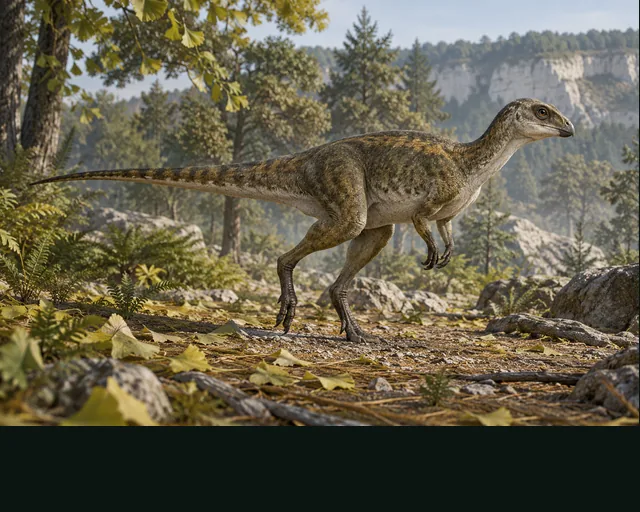
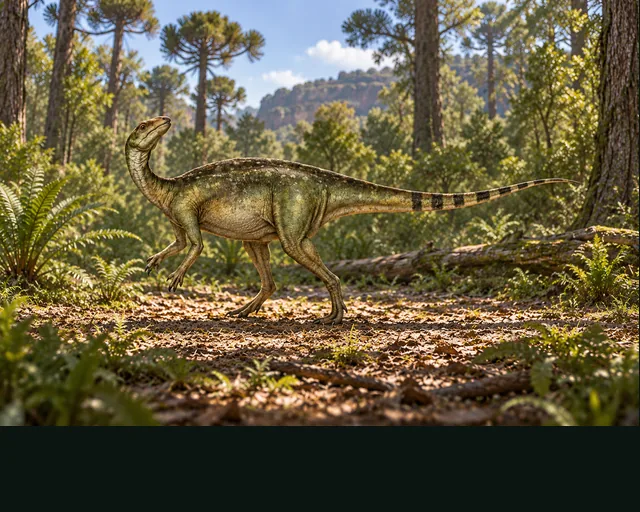
Our illustration follows the inspected, complete Chakisaurus reference, retaining its small blunt head, short forelimbs, long hindlegs and very long tapering tail. The extent of feather-like covering and the colours belong to the reference artist’s interpretation. They are not presented as preserved Chakisaurus plumage.
Compare Anabisetia and Hypsilophodon, or return to the C directory.
Quick answers
- What kind of dinosaur was Chakisaurus?
- An elasmarian ornithopod, a branch of plant-eating ornithischian dinosaurs.
- Why is its tail important?
- The study adds anatomical evidence for an otherwise incompletely understood region of elasmarian bodies.
- Does the name prove its running speed?
- No. Neither a name nor a slender illustration is a measured speed record.
- Why does this page differ from older Late Cretaceous summaries?
- A 2026 dating study places the Huincul Formation in the Albian, revising the chronology used by the 2024 description.