Jurassic Dinos editorial · Updated · Source-based review
What was Breviceratops?
Breviceratops was a small ceratopsian dinosaur from Late Cretaceous Mongolia. Ceratopsians are the beaked dinosaur group that includes Protoceratops and Triceratops, but many members lacked the spectacular horns familiar from their larger relatives. The species discussed here is Breviceratops kozlowskii.
Its naming history began as a species assigned uncertainly to Protoceratops in 1975. Kurzanov placed it in the separate genus Breviceratops in 1990. A changed genus name can reflect a revised interpretation of relationships without meaning that another fossil animal has appeared.
Which specimen carries the name?
The type is ZPAL MgD-I/117 from Khulsan in Mongolia’s Baruungoyot Formation. A 2019 reassessment described it as a small individual with an incomplete skull and articulated body material. Its missing skull regions matter: the study specifically notes that the nasal anatomy remains unknown.
A type specimen anchors a name, but it does not have to preserve every structure that an illustrator might draw. An incomplete face can still contain a useful combination of features for identification.
Why did some fossils change identity?
Earlier collections included specimens later recognised as Bagaceratops or as indeterminate protoceratopsids. The reassessment kept the Breviceratops type and a small referred skull separate on anatomical grounds, including teeth near the front of the upper jaw and features of the lower jaw and facial opening.
This is why the question “Are the two names synonyms?” needs a specimen-level answer. Some bones once placed under a name can be reassigned while the name-bearing specimen remains distinct. Moving part of a collection does not automatically move all of it.
How does growth complicate the comparison?
The study examined variation among small and larger protoceratopsid skulls. Features can change as an animal grows, and individuals of the same species can also differ. Researchers therefore test whether a difference marks a separate species, a growth stage or ordinary variation.
We do not enlarge the small type into a confidently measured adult or give it a complete adult head profile unsupported by the record. That would replace an interesting scientific question with artificial certainty.
What does our illustration represent?
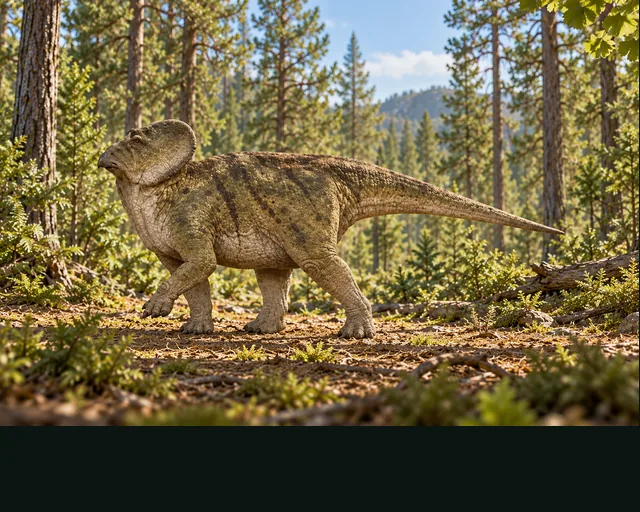
The complete reference is explicitly named Breviceratops and based primarily on the type specimen’s interpretation. Our image retains its short beaked face, modest frill, compact body and tapering tail. Finished nasal shape, colours and body proportions remain artistic, with the small-individual limitation kept visible.
Compare Protoceratops and Bagaceratops, then browse the B directory.
Quick answers
- Is Breviceratops just another name for Bagaceratops?
- The 2019 reassessment retained Breviceratops as distinct while moving several formerly referred specimens to Bagaceratops.
- Where was its type found?
- At Khulsan in Mongolia’s Late Cretaceous Baruungoyot Formation.
- Was the type a complete adult skull?
- No. It is a small individual with an incomplete skull, including missing nasal information.
- Does its name prove that it had a large horn?
- No. Name meanings do not establish unpreserved anatomy, and no Triceratops-like brow horns are added here.