
Jurassic Dinos editorial · Updated · Source-based review
What was Acrotholus?
Acrotholus was a small, dome-headed dinosaur from the Late Cretaceous of Alberta, Canada. Its name refers to the raised dome on the skull. That thick roof is the best-known part of the animal, and it raises a bigger question: how many small dinosaurs are missing from our picture of prehistoric life?
Where did the discovery come from?
Acrotholus audeti was named in 2013 using skull-dome material from the Milk River Formation. The discovery combined an older museum specimen with a better-preserved find made in 2008. The species name honours Roy Audet, whose ranch was the location of the newer discovery.
Museum collections are therefore part of the discovery process, not simply places where finished discoveries are stored. An older object may become much easier to interpret when a new specimen preserves features that were previously missing or difficult to recognise.
How large was Acrotholus?
The Royal Ontario Museum announcement estimated the animal at roughly two metres long and about 40 kilograms. These are reconstructed whole-body figures. The fossils do not consist of a complete animal ready to measure from snout to tail.
Its skull dome was already strongly developed, even though Acrotholus represents an early occurrence of this specialised dinosaur group. The 2013 study used that combination to discuss the history and diversity of pachycephalosaurs: dinosaurs whose name means thick-headed lizards.
Did it fight by head-butting?
Head contact has been proposed as a possible function of pachycephalosaur domes, but a thick skull is not a filmed record of behaviour. For Acrotholus, it would be too strong to describe a particular fighting technique as proven. Studying behaviour requires comparing anatomy, possible injuries and mechanical explanations, with uncertainties kept visible.
Why are small dinosaurs easy to miss?
The original research connected the discovery to an incomplete record of small-bodied dinosaurs. The kinds of bones that survive and are collected can affect the variety scientists recognise. A tough skull dome may be easier to identify than fragile fragments from the rest of the same animal.
That is a sampling problem: the fossils available to study need not be a perfectly balanced sample of the animals that once lived.
What does our picture show?
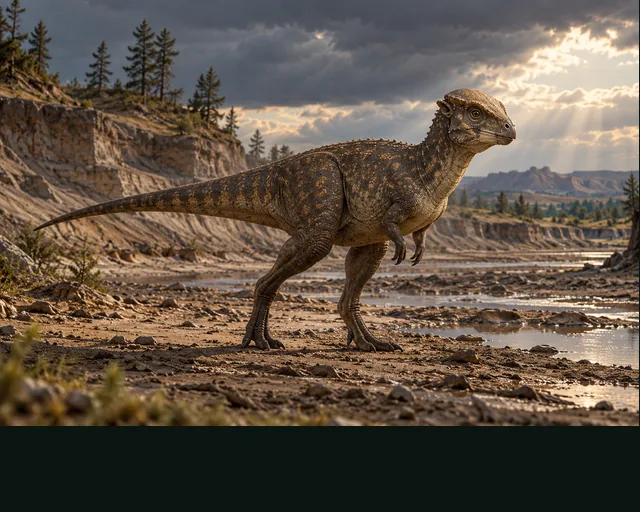
The AI illustration uses the approved, complete Acrotholus restoration for visible shape. The dome is central to its identity, but colours, skin and the surrounding scene remain artistic interpretations. A whole-body picture does not imply a whole-body fossil.
Explore Pachycephalosaurus, Homalocephale, or the A–Z directory.
Quick answers
- Where did Acrotholus live?
- Its skull-dome fossils come from the Milk River Formation in Alberta, Canada.
- How big was Acrotholus?
- The museum announcement estimates roughly two metres long and 40 kilograms, rather than reporting a complete-body measurement.
- Did Acrotholus head-butt?
- Head contact is a possible explanation for domes, but a specific fighting technique is not established for this animal.
- Why does this small dinosaur matter?
- Its fossils help researchers ask how preservation affects the small dinosaurs we can recognise.
![Nobu Tamura email:[email protected] http://spinops.blogspot.com/ http://paleoexhibit.blogspot.com/](https://commons.wikimedia.org/wiki/File:Acrotholus_NT.jpg)